The team retreated to a high-end, discreetly rented safehouse on the outskirts of Edinburgh to wait out the final hours before sunrise. The tension that had fuelled them for weeks was gone, replaced by the surreal, quiet exhaustion of absolute victory.
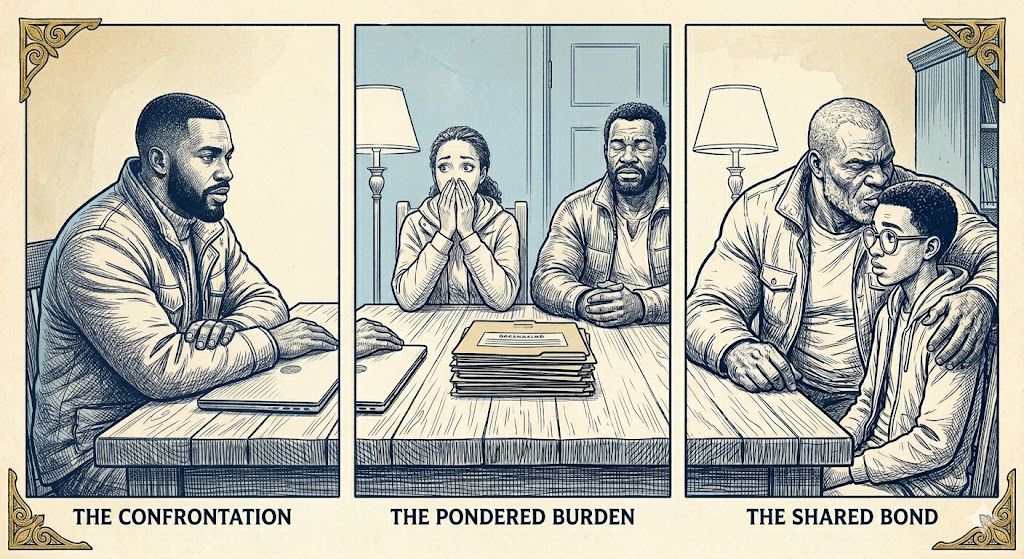
They sat around a large oak dining table. But unlike the movies, there were no briefcases of cash, and Kwesi’s laptop remained firmly closed. Instead, sitting in the centre of the table was a neat stack of thick, legal-sized manila folders.
Kwesi looked at the four people who had risked their lives, their freedom, and their futures for a man they barely knew. They had bled together, frozen together, and stared down the barrels of Syndicate rifles together.
“I made a promise,” Kwesi said, his deep voice breaking the silence in the room. He leaned forward, resting his forearms on the table. “A debt of blood is paid in full. We have the money. All of it. I am giving each of you one hundred and fifty million pounds”
Amina let out a shaky breath, her hands covering her mouth. Malik, the hardened fisherman who had spent his entire life fighting the unforgiving sea for pennies, closed his eyes, a profound relief washing over his weathered features. Moussa pulled his son close, kissing Youssour on the forehead before looking at Kwesi, tears welling in his scarred eyes.
“You have given us the world, my brother,” Moussa whispered.
“You gave me my life in Abidjan,” Kwesi replied softly, meeting the big Ivorian’s gaze. “But I need you to listen to me very carefully. If I transfer one hundred and fifty million pounds into your accounts tonight, you will be dead or in Belmarsh Prison in a few weeks.”
The warmth in the room instantly evaporated. Malik sat up straighter. “What do you mean?”
“In less than twenty-four hours, the descendants of the Syndicate are going to break open those wooden crates in London,” Kwesi explained, his tone commanding their absolute attention. “They are going to find our fake gold. When they do, their humiliation will turn into a violent, absolute rage.”
Kwesi tapped the folders on the table. “The Syndicate monitors everything. The banks, the registries, the streets. If two refugees, a fisherman, and a university student suddenly start buying mansions in Bath and driving supercars, their fixers will find you in a week. To survive this, you cannot be shadows. You have to hide in the blinding light.”
He slid a folder to Amina and Malik.
“Amina, Malik. Because you are UK citizens, you are now the official founders and directors of a new tech-hardware startup. All the incorporation documents are in there.” Kwesi turned to Youssour. “Those mechanical prototypes you sketched out during those brutal shifts at the shipyard? They are brilliant. They are going to be the hardware backbone of the company. I will build the software to integrate them.”
Moussa frowned, looking at the papers. “And us? Youssour and I?”
“You are officially recognised refugees with the right to work,” Kwesi said, sliding the remaining folders to them. “You are the startup’s first employees. You have ironclad contracts, good salaries, and most importantly, massive employee stock options.”
Amina flipped through the dense legal jargon, her sharp mind catching up to Kwesi’s logic. “We build the company… but how does that give us our cut of the heist?”
“You go back to your lives. You play the part of struggling, ambitious entrepreneurs for six months,” Kwesi said, a faint, razor-sharp smile touching his lips. “Let the Syndicate tear London apart looking for five dead gold hunters. In six months, a massive offshore venture capital firm from the Caymans, a firm that I secretly control and have already funded with our money, will swoop in and acquire your startup.”
The realisation dawned on Malik, his eyes widening. “They buy the company…”
“For six hundred million pounds,” Kwesi finished. “Amina and Malik, you declare the sale to HMRC. You pay your Capital Gains Tax with a smile. The buyout triggers Moussa and Youssour’s stock options. The money washes through the government’s own hands and becomes flawlessly, legally yours. You won’t just be rich. You will be legitimate tech millionaires.”
Silence fell over the Scottish safehouse as the sheer scale of the deception settled in. It wasn’t just a heist; it was a legal play on the British economy.
Moussa let out a deep, rumbling laugh that shook his chest. Amina wiped a tear from her cheek, a fierce, genuine smile breaking across her face. They didn’t need fake passports or a life on the run. Kwesi had given them the ultimate weapon: legitimacy.
As the sun began to rise over the Scottish hills, the team stood up. The goodbyes were quiet but carried the heavy, unbreakable bond of soldiers who had survived a war. Moussa embraced Kwesi one last time, a silent exchange of absolute brotherhood. Amina hugged him tightly, whispering her final gratitude before slipping out the door with Malik.
Within an hour, the safehouse was empty. The crew had vanished into the morning mist, not to flee, but to go to work.
Kwesi stood alone in the quiet room. He packed his encrypted laptop and Forson’s fragile 1956 map into his canvas bag. His physical business in the United Kingdom was officially concluded. He could write the startup’s code and manage the dummy corporation from anywhere in the world.
It was time to return to the humid, dusty streets of Guinea. He had one final promise left to fulfil, and he would do it from the shadows.
Kwesi hadn’t stowed away in the dark, freezing hull of a cargo ship to return to West Africa. The days of surviving on rust and saltwater were over.
Utilising his newly acquired capital, he had tapped into the elite global market of golden visas, programs that offer fast-tracked residency or citizenship by investment.
Seeking immediate global mobility, he bypassed standard immigration delays and utilised Vanuatu’s fast-processing program
With a swift $130,000 donation, Kwesi legally acquired a new citizenship and a pristine passport.
Armed with this “golden passport” and an airtight alias, the former fugitive simply booked a first-class commercial ticket. He drank sparkling water at thirty thousand feet, crossing the same ocean that had nearly claimed his life months prior.
When he stepped off the plane, the thick, humid air of Conakry was a violent contrast to the freezing winds of the Scottish Highlands. The capital of Guinea smelled of salt spray, diesel exhaust, and roasting plantains. For Kwesi, the chaotic symphony of the market streets and the red dust coating his boots felt like a long-overdue homecoming.
He didn’t check into a hotel. He didn’t secure a safehouse. Straight from the airport, carrying only his canvas bag, he navigated the streets of Conakry to a quiet, unassuming neighbourhood. He stopped in front of a modest concrete home shaded by a sprawling mango tree.
When he knocked, the door was opened by Kofi Jean-Luc. The younger man froze, his eyes widening before a massive, disbelieving grin broke across his face.
“The Titan returns,” Kofi laughed, pulling Kwesi into a fierce embrace.
Inside, the house smelled of rich palm nut soup. Mariam emerged wiping her hands on an apron. When she saw Kwesi, she gasped, dropping the cloth and rushing forward to pull him into a motherly hug that reminded him of a warmth he hadn’t felt in years.
“You are thin, Kwesi,” she scolded gently, holding his face in her hands. “But your eyes… the storm in them is gone.”
“I am well, Mama Mariam. Because of you. Because of Kofi,” Kwesi said softly. He looked around the modest living room, remembering the days when he had nothing but the clothes on his back and the memories of his torture. “I made a promise to Old Man Forson that his kindness would not be forgotten.”
Kwesi reached into his jacket and pulled out a heavy, encrypted tablet. He set it on the small wooden dining table and gestured for Kofi to look. He typed in a master sequence, revealing a pending offshore trust.
Kofi stared at the screen, taking off his glasses and wiping them on his shirt before looking again. “Kwesi… four hundred million pounds. This is an empire.”
Mariam’s legs gave out, and Kwesi quickly caught her, easing her into one of the dining chairs. She stared at the tablet, tears immediately spilling over her cheeks.
“The Turman gold is gone,” Kwesi said, his voice steady. “But if I transfer this directly to you now, the Guinean government will seize it, and you will be in danger. We have to wash it. We have to make you legitimate owners.”
Kwesi tapped the screen, pulling up local business registries. “Kofi, you are a mechanic and a tech genius. Find a struggling car or tech business here in Conakry. Buy it this week using a small advance I will send you. Put Mariam on the board of directors. For the next six months, you are going to run that failing business.”
Kofi looked up, the brilliant strategy dawning on him. “And then?”
“And then, in six months,” Kwesi smiled, “a massive Cayman Islands venture capital firm, which I control is going to aggressively expand into West Africa. We are going to ‘acquire’ your struggling company and inject one hundred million pounds into it as foreign direct investment. You and your mother won’t just be rich. You will be legitimate, untouchable telecommunications magnates. Over the course of two years, we will invest the remaining four million pounds into other struggling businesses that you will acquire.”
Six months later.
Kwesi sat on the balcony of a modest, heavily secured villa in Conakry overlooking the Atlantic. In the spare bedroom, a localised server rack hummed quietly, bouncing heavily encrypted signals through a dozen proxy satellites.
He checked the heavy dive watch on his wrist. It was 9:00 AM in London. Exactly six months had passed since the morning in the Scottish safehouse and his arrival in Conakry.
It was time.
Kwesi opened his laptop and accessed the offshore portal for Apex Horizon Ventures, his dummy corporation. With a slow, deliberate exhale, he executed the dual sequences.
First, he authorised the acquisition of Amina and Malik’s UK startup. He watched the transfer of six hundred million pounds clear, washing cleanly through the British financial ecosystem, legally turning the London crew into tech millionaires.
A moment later, he authorised the Guinean acquisition. One hundred million pounds slammed into the corporate accounts of Kofi’s acquired, previously struggling telecom startup.
A few minutes later, his phone buzzed with a single, encrypted message. It was a photo of Amina, Malik, Moussa, and Youssour raising a quiet toast in a sunlit London café.
A second later, a local text message arrived from Kofi: Mama Mariam says you are late for dinner, Mr. CEO.
Kwesi smiled, a genuine warmth spreading through his chest. He crushed the burner phone and tossed the battery into the ocean below. The London crew was safe. Old Man Forson’s memory was honoured. His debts were finally paid in full.
A few minutes later, the news aggregators on his second screen began to light up with international and local financial alerts. UK Tech Startup Acquired in Blockbuster £600M Deal. And right beneath it: Massive Foreign Investment Injects £100M into Guinean Telecom Infrastructure.
He turned his attention back to the table, looking at the encrypted files detailing Jude Asamoah, Kojo Danso, and the corrupt officials in Ghana. He still had one billion pounds left in his arsenal. The destitute prisoner, Kwesi Dankwa, had honoured his past.
Now, billionaire investor “Nana K” was ready to plan for his return to Ghana, secure justice and clear his name as an ex-convict. It was time for the Golden Titan to make his Golden Return.


