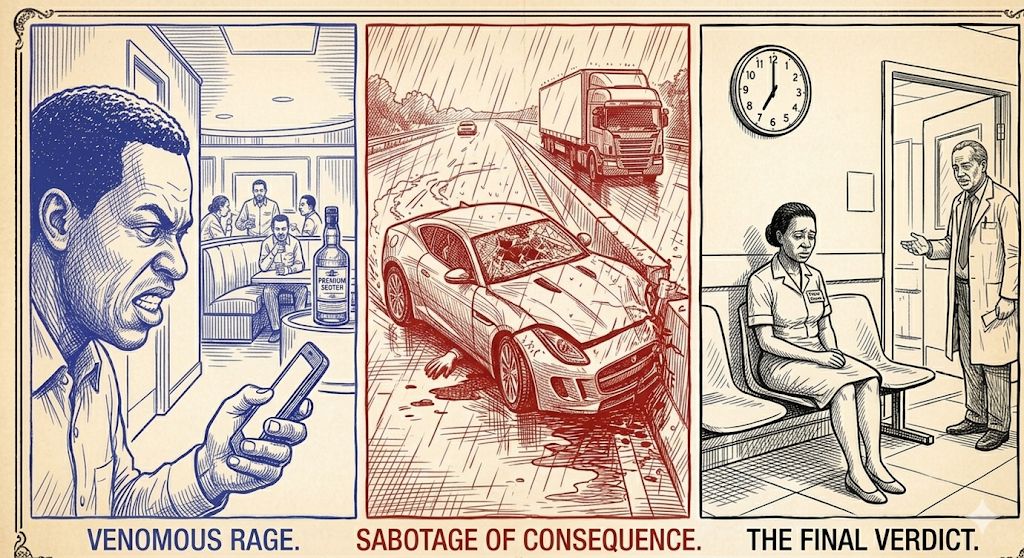
The transition from the clinical wards of Korle-Bu back to the opulent fortress in Community 10 took six gruelling weeks. When Osei finally returned home, navigating the threshold in a heavy, motorised wheelchair, the dynamic of their marriage shifted from a tense battleground into a cold, desolate wasteland. This marked the true beginning of the “Great Silence”.
Osei returned not as a humbled survivor, but as a fractured, embittered tyrant. His deep-seated insecurity, which he had previously masked with tailored clothing and expensive liquor, curdled into pure, unadulterated cruelty. He could not accept his own physical inadequacy, nor could he accept fault for the reckless driving that had caused it. Like poison seeking an outlet, he projected the entirety of his bitterness onto Abena.
“If you had just stayed home and not take on those additional night shifts,” Osei hissed one evening. His eyes were dark with malice as he sat in his chair in the centre of the living room, watching her clear away his untouched dinner. “If you hadn’t lost my baby, I would never have been on that road in the rain. You did this to us.”
Abena did not argue back. The fight had completely drained out of her. She simply turned and walked into the kitchen, the silence of the large house pressing down heavily upon her shoulders.
As the months bled into years, their home became a beautifully furnished social prison. The knowledge of his sterility corroded whatever was left of Osei’s humanity. He wielded his bitterness like a weapon, verbally striking her constantly. Yet, despite the venom he spat behind closed doors, Osei was absolutely terrified of public humiliation. A divorce was out of the question. A ‘Big Man’ in Tema, a corporate titan ascending the ranks of the port’s elite, could not be seen as a discarded, broken husband.
He anchored her to him, forcing Abena to maintain a flawless societal charade. They attended social functions and corporate galas like impeccably dressed mannequins. He used his wealth and influence to ensure her family in Patasi supported their marriage, isolating her entirely from the few people who might have thrown her a lifeline.
Abena retreated inwards. She requested permanent transfers to the night shifts, trading the daytime horrors of her own home for the exhausting, noble chaos of the paediatric ward. She slept in a separate wing of the house, ate her meals at the kitchen counter, and lived entirely parallel to the man she had married.
Looking out through the reinforced iron bars of her bedroom window toward the distant, flashing lights of the harbour, the absolute tragedy of her situation finally settled over her.
She had sought an escape from waiting for Kwesi Dankwa, an absent shadow. Desperate for the warmth and security of a tangible family, she had marriage the man who was always present. But looking at the cold, empty walls of the Community 10 compound, Abena realised the horrific truth. To her, Kwesi, the Golden Boy, was behind bars at the Ashanti Central Prison, and she was a prisoner behind the bars of a mansion at Community 10 in Tema.
————-
The port of Nakiri-Sud in Conakry was a sprawling, rusted beast of commerce that devoured human sweat and spat out global cargo. It operated on a relentless, brutal frequency, choked with the exhaust of heavy shipping vessels and the deafening clatter of gantry cranes. Here, on the edge of the Atlantic Ocean, Kwesi Dankwa shed the final, lingering vulnerabilities of his past.
His first year in Guinea marked the eleventh year since he had been stripped of his life in Kumasi. Life in Conakry demanded a completely different kind of survival than the quiet, paranoid existence he had maintained in Abidjan. To cross the ocean to the United Kingdom as an undocumented, invisible shadow, he needed more than just the cypher hidden in Old Man Forson’s ledgers. He needed a body capable of surviving weeks inside a freezing, unventilated steel shipping container.
He found his training ground on the iron docks of the port of Nakiri-Sud.
Kwesi secured work as a stevedore, a dockworker responsible for loading and unloading cargo between ships and land transportation. It was the lowest-paying and most punishing job at the port, but it provided him the anonymous existence that he needed. For twelve hours a day, under the merciless, baking glare of the Guinean sun, he hauled fifty-kilo sacks of rice, raw bauxite, and cement from the cavernous holds of cargo ships. The salt air stung his eyes, and the abrasive canvas of the sacks rubbed the skin of his shoulders raw.
He did not complain, nor did he seek the shade when the midday heat forced the other labourers to their knees. He embraced the agony. Every searing pain in his muscles, every drop of sweat that stung the scars he had acquired in Treichville, was a deliberate, calculated step towards his resurrection. He was intentionally breaking his body down to rebuild it into an unbreakable machine. The soft, tailored logistics manager who had once been dragged from his knocking ceremony was entirely eradicated. In his place stood a lean, heavily muscled phantom, his skin hardened like cured leather, his eyes fixed on a distant, British horizon.
When the warning sirens blared at dusk, signalling the end of the shift, Kwesi would collect his daily wages in crumpled Guinean francs. He did not join the other stevedores at the local maquis for cheap beer and loud music. He washed the worst of the toxic port grime from his arms at a communal tap, wrapped his frayed jacket around his shoulders, and began the long walk back to the Dixinn slum.
Lot 42, the crumbling cinderblock compound behind the ruined chapel, had slowly transformed over the past year.
When Kwesi first arrived, the home of Mariam and Kofi Jean-Luc had been a portrait of absolute, grinding destitution. But the quiet infusion of Kwesi’s port wages, along with those of Kofi Jean-Luc, had initiated a steady resurrection of their dignity. He had purchased fresh, un-rusted corrugated iron to patch the gaping holes in the roof, finally keeping the torrential rains out of their small living space. He brought back fresh vegetables, proper meat, and the vital medications Mariam desperately needed for her failing joints.
As Kwesi pushed open the wooden gate one evening, the smell of rich, spiced groundnut soup drifted across the yard. It was a scent that violently yanked his memory back to the warm kitchen of Mrs Ofori, Abena’s mother, but it was a memory of a life and a woman that now belonged to Osei. He forced the memory down, locking it away in the dark vault of his mind. He could not afford the luxury of grief; grief was a vulnerability he had left at the Elubo border.
“You are late today, Nana,” Kofi Jean-Luc said, stepping out from the shadow of the struggling mango tree. The younger man was wiping thick black grease from his hands with a rag.
The initial, bitter suspicion Kofi had harboured towards the stranger from Ghana had completely evaporated. Over the months, witnessing Kwesi’s punishing work ethic and his quiet, fierce devotion to Forson’s family, Kofi had come to view him not just as a messenger, but as an older brother.
“A Russian freighter came in late,” Kwesi replied, his voice a low, gravelly rasp from breathing diesel fumes all day. He reached into his pocket and handed a folded stack of francs to Kofi. “For the market tomorrow. Make sure Maman gets the good cuts of fish.”
“You are giving us too much,” Kofi argued softly, pushing the money back. “You break your back on those iron docks, Nana. You need to save this for your passage to London. If you give us everything, you will never leave this slum.”
Kwesi smiled, a rare, fleeting softening of his hardened features. He placed a heavy, calloused hand on Kofi’s shoulder, pressing the money firmly into the mechanic’s palm.
“We do not leave people behind in the dark, Kofi. Your father taught me that in a place much worse than this,” Kwesi said, his tone leaving no room for debate. “The departure fund is growing. The physical preparation is nearly complete. My body can endure the crossing.”
Kwesi looked past the rusted gate, towards the distant, invisible shoreline where the massive container ships sat anchored in the black water.
“But brute strength will not get me onto a vessel bound for Tilbury Docks without setting off alarms,” Kwesi murmured, his eyes narrowing with a sharp, analytical focus. “To slip past the harbour authorities and survive the voyage, we must outsmart the system. Tonight, we stop lifting weight, Kofi. Tonight, we open the ledgers.”


