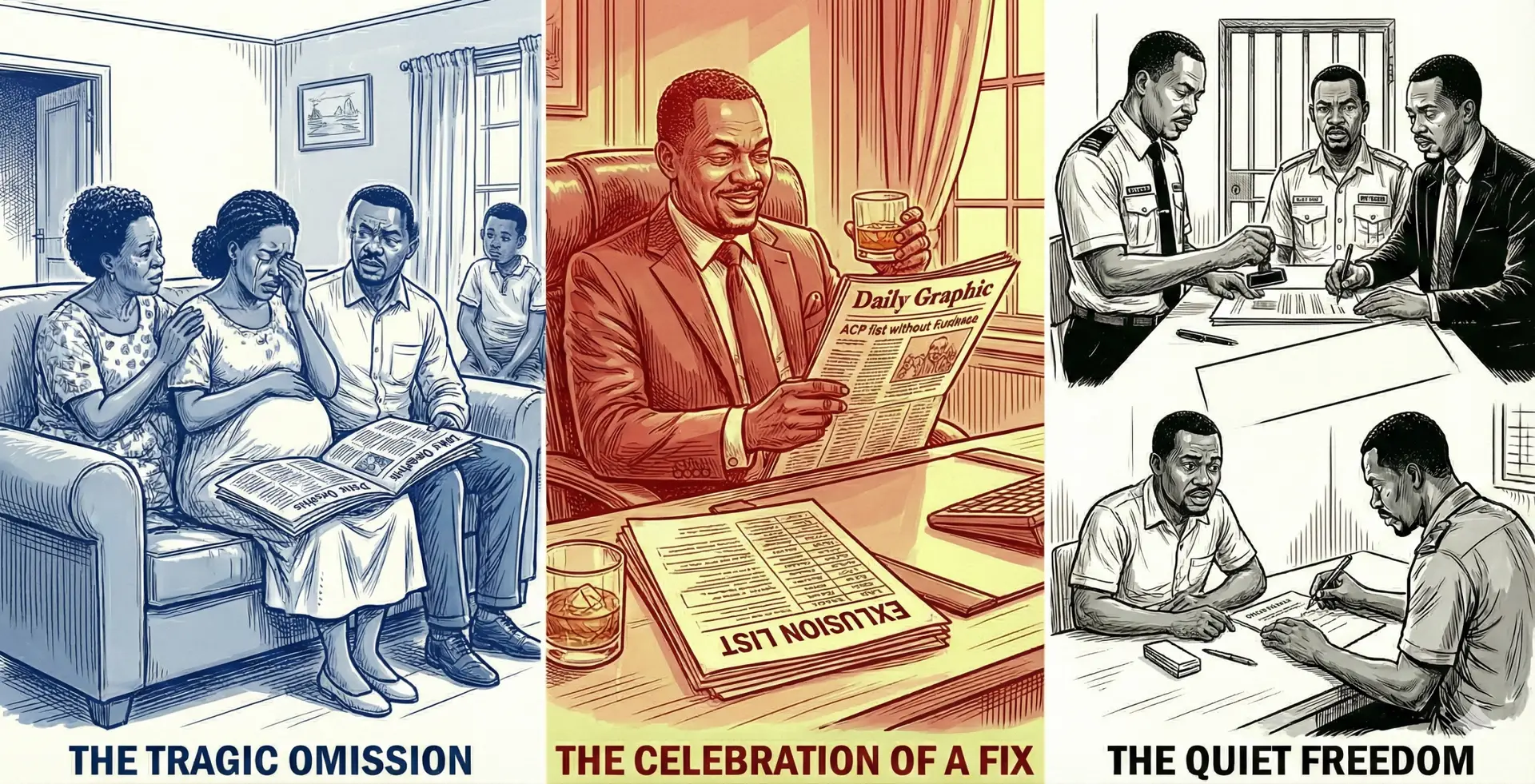
Jude Asamoah was not the only one calculating the risks. In his retirement villa in Kumasi, Asamoah Snr sat in a plush leather armchair, his eyes fixed on the news ticker of his huge TV. He was a man who had built an empire on predicting the wind, and right now, the wind was carrying the scent of a storm.
A week ago, Jude had travelled to the United States, his wife, Cynthia was already in New Jersey. She was in her ninth month and ready to deliver the Jude’s second child. Although he was away physically, Jude was keeping tabs on the happenings back home in Ghana. But
Asamoah Snr wasn’t a man who took chances when he had so much to lose. He picked up his phone and dialled Jude’s number. “I am coming to the United States,” he told Jude over. “My grandchild is due in three days. It is only right that I am there.”
“You’re running,” Jude snapped, his voice tight with frustration.
“I am securing my legacy, Jude,” the old man replied, his voice chillingly calm. “If Kwesi Dankwa walks out of those gates, he will look for the man who signed the waybills. I am no longer that man. I am a grandfather visiting his family. You, however, are the Head of Anti-Corruption. You are the one who burned the ledger. You are the one he will find.”
Asamoah Snr hung up, leaving Jude alone in the silence of his New Jersey apartment. The realisation hit him like a physical weight: his father had provided the logistics for the crime, but, he, Jude had provided the betrayal. He was the one standing on the front line.
Jude moved with the precision of a cornered predator. He knew the Ministry of Social Justice was setting up a committee to vet the prisoners. He also knew that one of the middle-ranking directors at the PACU, a man named Tetteh who owed his entire career to Jude’s patronage, had been appointed to the committee’s technical team.
“Tetteh,” Jude said, as Tetteh pickup up the phone. “The ACP list. I want it you to send me a copy as soon as the CIO of ACP sends it to you and before it goes to the President. There is a prisoner there, Kwesi Dankwa. He is a non-violent offender, yes. He has served eight years, yes. But he is also a person of interest in an ongoing national security audit. If he is released, the audit is compromised.”
“I understand, Director. ” Tetteh replied. “I will ensure he is flagged for ‘Administrative Review.’ His name will never make it to the final approval.”
But Jude’s reach was not as absolute as it had been eight years ago. In Kumasi, Lawyer Kwarteng had spent nearly a decade waiting for a crack in the wall. He had been monitoring the committee’s progress through his own networks, a private investigator who had a cousin working as a clerk in the Ministry of Social Justice.
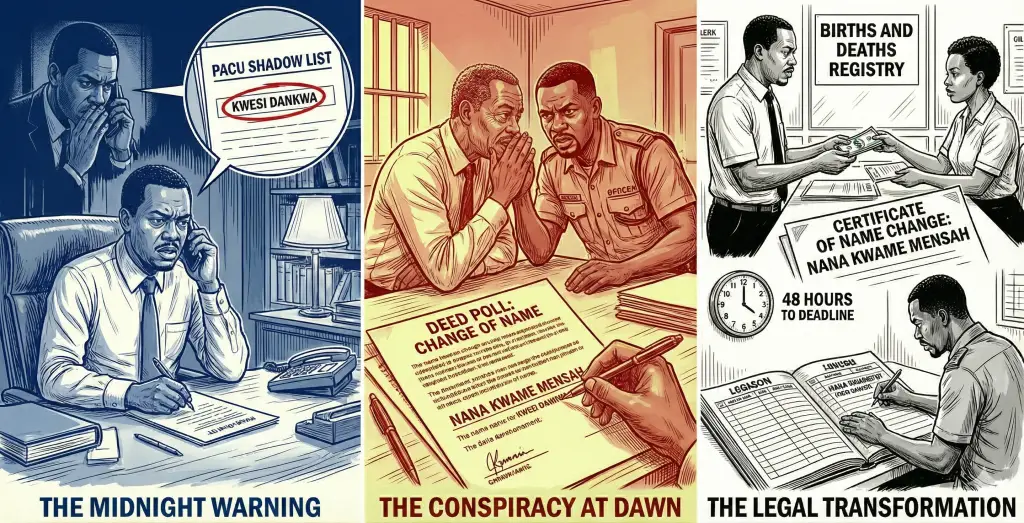
The call came at midnight. “Lawyer,” the PI whispered. “A of list 25 prisoners came in from the PACU today. It was a ‘shadow list’ of names to that the PACU wants excluded from the amnesty due to national security. Kwesi Dankwa is on the list. They are tagging him as a security risk.”
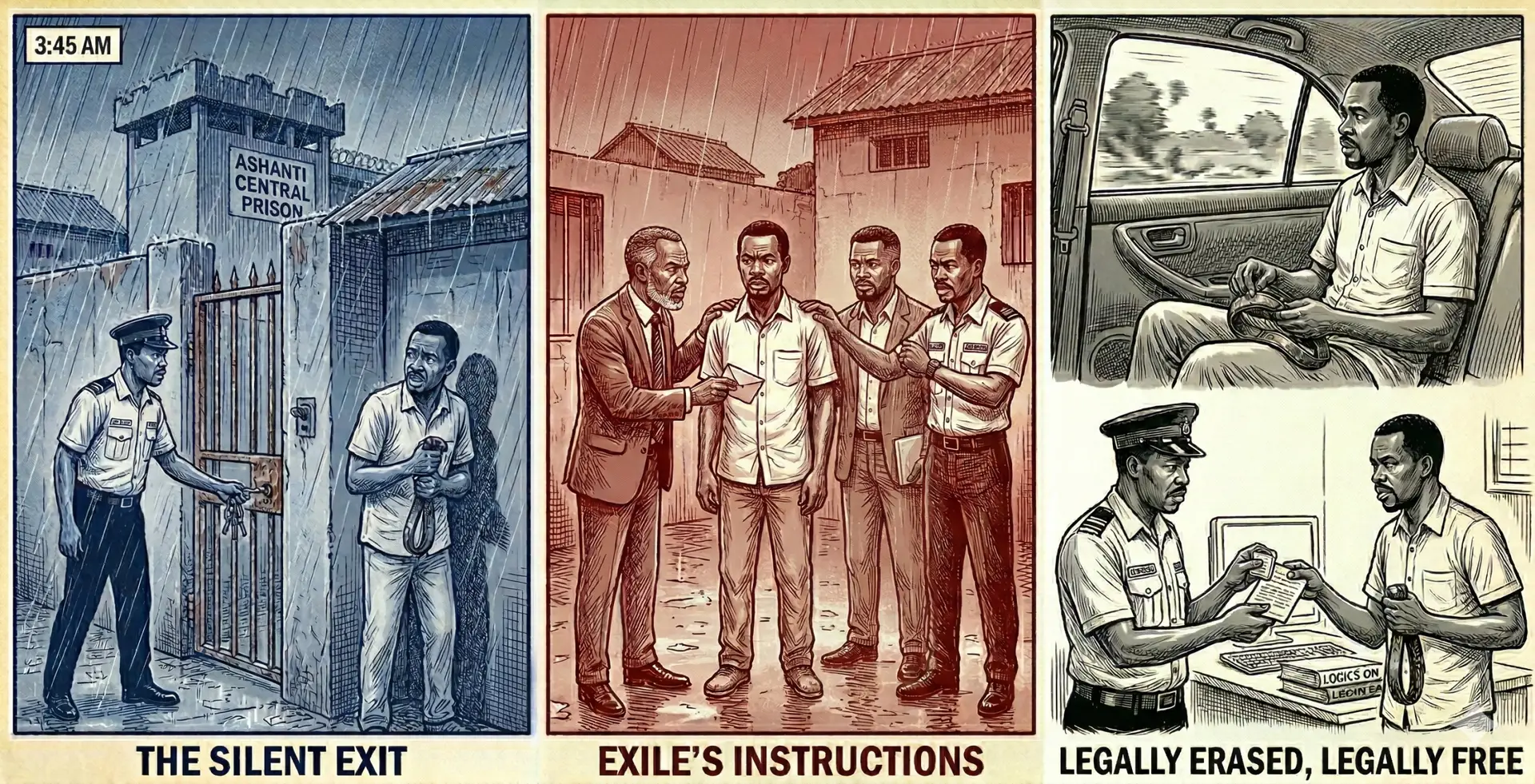
Kwarteng didn’t sleep. The next morning, he drove straight to the Ashanti Central Prison. By dawn, he was sitting in the office of CIO Owusu. The former guard was now the Officer-in-Charge, a promotion won through the very discipline and order Kwesi had helped him maintain in the West Wing.
“They are going to block him, Owusu,” Kwarteng said, leaning across the desk. “Jude has a man on the committee. If the name ‘Kwesi Dankwa’ appears on your recommendation list, it will be crushed before it even reaches the President’s desk.”
Owusu looked out the window at the morning roll call, his brow furrowed. “I know. But I cannot omit him. He is the most qualified candidate for reform in this entire facility. If I skip him, it looks like I’m incompetent. If I include him, Jude marks him for exclusion.”
“Then you won’t include Kwesi Dankwa,” Kwarteng said, his voice dropping to a conspiratorial whisper. “You will include Nana Kwame Mensah.”
Owusu blinked, confused. “A fake name? Owusu, if Jude audits the books later and finds a phantom walked out—”
“It won’t be a phantom,” Kwarteng interrupted. “It will be a legal reality. Every citizen, even a prisoner, has the right to a change of name by deed poll. I can have the papers ready by noon. I have a contact at the Births and Deaths Registry who informs me that if we pay for express service, the filing and name change can be completed in less than 24 hours. By tomorrow morning, it will be official. Kwesi Dankwa will legally cease to exist, replaced by Nana Kwame Mensah.”
Owusu leaned back, the genius of the plan slowly taking root. “And I simply update the prison logs to reflect the prisoner’s new legal name.”
“Exactly,” Kwarteng said. “This insulates you completely. You aren’t playing favourites or hiding a criminal. You are simply performing your administrative duty by using the prisoner’s current legal identity on your recommendation list. If Jude questions it years from now, you simply point to the legal file in your cabinet. You were just following procedure.”
Owusu looked at the lawyer, a small, grim smile appearing on his face. “A legal name change. It’s clean. It’s standard. Jude is looking for a target, not a clerical update.”
“He must be a shadow before he is a man,” Kwarteng whispered.
“Exactly,” Owusu replied. “But we must move fast. The President signs the final decree in forty-eight hours. By then, the name Kwesi Dankwa must be buried in your briefcase, and Nana Kwame Mensah must be the one on my list.