By the eighth year of Kwesi Dankwa’s sentence, the “Golden Boy” had become a myth in the streets of Adum, but in the halls of power, a new storm was brewing. It wasn’t a storm built on his name specifically, but on the thousands of names the state had simply chosen to forget.
The catalyst was Hilda Allotey.
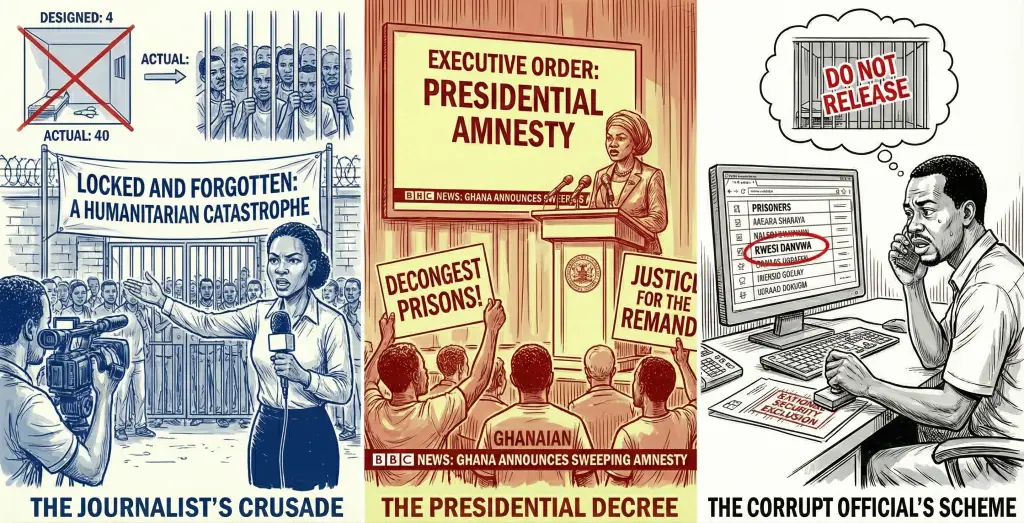
A fierce, relentless investigative journalist, Hilda had spent three years documenting the collapse of the Ghanaian penal system. Her documentary, Locked and Forgotten, was a visceral, horrifying journey into the bowels of prisons like the ACP. She didn’t focus on high-profile inmates; she focused on the “Remand and Forgotten”, men and women who had been arrested for petty theft or minor disputes and had spent seven, eight, or ten years in a cell without ever seeing a judge.
She stood before the camera in the sweltering heat outside the Nsawam and Ashanti prisons, showing diagrams of cells designed for four men now holding forty.
“We are running a warehouse of human misery,” Hilda told the nation during a prime-time broadcast. “We have facilities built for 400 inmates currently housing 4,000. These are not just prisoners; they are casualties of a judicial system that has stopped breathing. We have fathers who have vanished into the system while awaiting a single court appearance that never comes.”
When the documentary aired, it didn’t just spark a conversation; it ignited a global outcry. It was picked up by the BBC and Al Jazeera, becoming a symbol of the “Justice Delayed” crisis in West Africa. Hilda stood before the African Union and the UN, citing statistics that made even seasoned diplomats flinch. She argued that the overcrowding was no longer a domestic administrative issue, but a humanitarian catastrophe.
The global pressure mounted like a rising tide. In London, during a high-profile state visit, President Jemila Alhassan was confronted not by trade questions, but by a sea of placards held by the Ghanaian Diaspora. They were chanting for “Justice for the Remand” and “Decongest our Prisons!”
The international media pressed the President during a televised interview at the Commonwealth Secretariat.
“Madam President,” a journalist asked, “your country prides itself on being the gateway to Africa, yet your prisons are at 400 percent capacity, filled with people who have never been sentenced. How do you reconcile this with your human rights record?”
President Alhassan, realising that her international reputation and future IMF negotiations were at stake, made a calculated, sweeping move. She leaned into the microphone, her expression one of profound resolve.
“The conditions exposed by the Locked and Forgotten documentary are unacceptable to this administration,” she stated. “Upon my return, I will be signing an Executive Order for a Presidential Amnesty. We will immediately decongest our facilities by granting a pardon to every non-violent inmate who has served more than five years, and we will establish a fast-track court to resolve the cases of every remand prisoner.”
Back in Ghana, the news was a thunderclap. For Hilda Allotey, it was the culmination of a life’s work. For the inmates in prisons like ACP, it was a roar of hope that shook the bars.
But for Jude Asamoah, sitting in his office at the PACU, the news was a different kind of sound: the ticking of a clock. He didn’t care about the 3,999 other prisoners. He cared only that the criteria for amnesty, those who served over five years, acted like a wide net. And in that net, no matter how deep he had buried him, sat Kwesi Dankwa.
“The President is opening the gates for the ‘forgotten,'” Jude whispered, staring at a list of ACP inmates on his screen. “But some men are forgotten for a reason. If this general amnesty catches him, the truth of the Dankwa case walks out with him.”
He realised he couldn’t stop the President’s decree without looking like an enemy of justice, but he could influence the list. He reached for his phone, his mind already working on a way to ensure that while 500 men walked free, one specific prisoner would be flagged as a “National Security Exclusion.” The general fight for justice had provided the opportunity, but Jude was about to make it a very personal war.