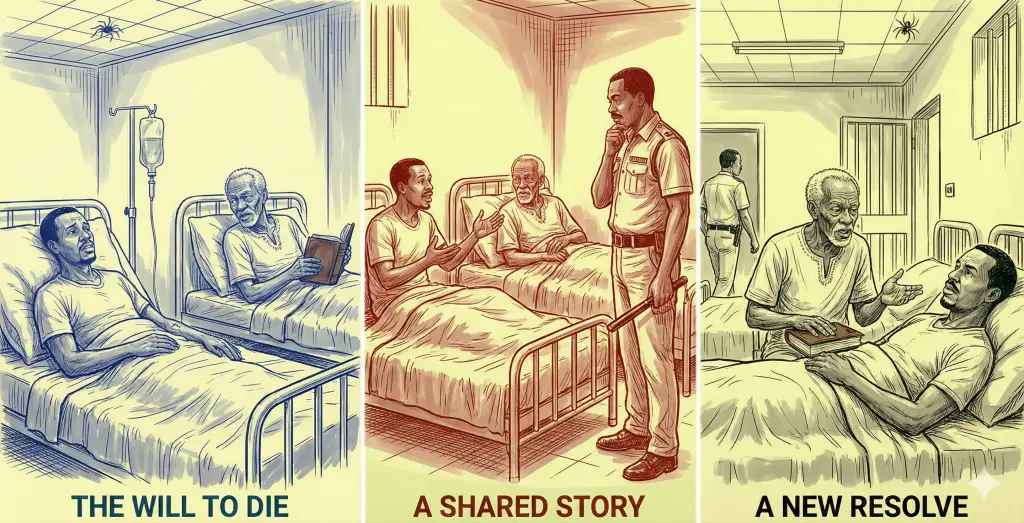
The white, fluorescent light of the infirmary ceiling felt like a physical assault on Kwesi’s eyes. He stared upward, watching the slow, rhythmic crawl of a spider across the peeling plaster, his mind as blank as the walls. The saline drip hissed softly, a tiny, synthetic heart beating for him because his own had given up.
“It is a fascinating thing, the will to die,” the voice from the next bed continued. Old Man Forson was propped up on thin pillows, his skeletal hands clutching a battered, leather-bound book. “It requires more energy than living, you know. To actively refuse the air, the water, the light… it is a monumental labour. And for what? To give those who hurt you the final victory of your silence?”
Kwesi shifted his gaze. Forson looked like a piece of ancient history carved from wood. His hair was a halo of white wool, and his voice carried the cultured, precise cadence of a man who had spent his life among scholars.
“I have nothing left to give them,” Kwesi whispered, his throat raw.
“You have your story,” Forson countered, his eyes narrowing. “A story is the only thing the state cannot classify. I have been in this clinic for three days, watching you. Officer Owusu told me you are the Librarian. A lover of books. And yet, here you are, trying to burn your own library before the last chapter is written.”
Kwesi closed his eyes. “The woman I loved is marrying my cousin. My father is a shadow in Ejisu. I am in a cell for twenty years for a crime I did not commit. Tell me, old man, what chapter is left?”
Forson let out a dry, rattling laugh. “I am eighty-four years old. I have chronic diabetes, a failing heart, and a ten-year sentence for a mistake I made in my seventies. I have spent six years here and four more to go. By the laws of biology, I should have been under the earth years ago. But I stay, young man. I stay because I want to see the end. I want to see if the world still knows how to turn.”
Forson leaned closer, the scent of antiseptic and old paper clinging to him. “Owusu tells me you were a logistics manager. A clever boy with computers. He says you are trying to kill yourself because of a woman. A woman is a tragedy, yes. But a woman is not the law. Betrayal is not the end of the world; it is the beginning of wisdom.”
“Wisdom doesn’t open gates,” Kwesi snapped, a spark of his old fire flickering in his eyes.
“No,” Forson smiled, a slow, knowing expression. “Knowledge opens gates and buys the key. But despair? Despair only builds the wall higher.”
Over the next hour, as the ward grew quiet and the night shift nurses dozed at their station, Kwesi found himself doing something he hadn’t done in five years. He didn’t speak as a prisoner; he spoke as a man. He told Forson everything: the success in Adum, the envy of Kojo, the betrayal of Jude Asamoah, the lies of Agyeman and the slow, agonising theft of Abena by Osei.
Forson listened with a stillness that was unnerving, his eyes never leaving Kwesi’s face. When Kwesi finally finished, the old man didn’t offer sympathy. He offered a challenge.
“They have framed you with official documents and a crooked prosecutor,” Forson mused. “It is a beautiful trap. Simple. Elegant. But every trap has a designer, and every designer has a signature. You have been studying criminology, yes? Sherlock Holmes? Lupin?”
Kwesi nodded, surprised.
“Those men were amateurs compared to the reality of power,” Forson said. “But they understood the most important rule: the mind is the only weapon that never rusts. You have fourteen years left. You can spend them dying in a bed, or you can spend them becoming the man who dismantles their empire from within.”
The door to the ward opened, and Officer Owusu stepped inside. He looked between the two men, noting the colour returning to Kwesi’s cheeks. He had seen the way Kwesi and Forson looked at the world, as a puzzle to be solved, not a burden to be carried.
“You’re talking,” Owusu said, his voice low. “That’s a good sign, 4405. The OIC wants to move you back to the block tomorrow.”
“Don’t,” Forson interrupted, his voice authoritative despite its frailty. “Officer, this boy needs a teacher, and I need a student who can still read small print. Move him to the Special Management Wing. Cell 12. Next to mine. He is the Librarian; he needs to be near someone who knows what is in the books.”
Owusu hesitated, knowing the risk, but he saw the shift in Kwesi, the way the apathy was being replaced by a cold, focused intent. “I’ll see what I can do. But if you two start a riot with your talk, I’m the one who loses his stripes.”
As Owusu left, Forson turned back to Kwesi. “Go back to your fluids, young man. Sleep. Tomorrow, we stop being victims. Tomorrow, we begin the work.”
Kwesi lay back, the spider on the ceiling finally reaching the other side. For the first time in fifteen days, he felt the hunger. Not for the porridge, but for the knowledge the old man carried. The “North Star” of Abena had gone out, but in the dark of the infirmary, a new, colder light was beginning to rise.