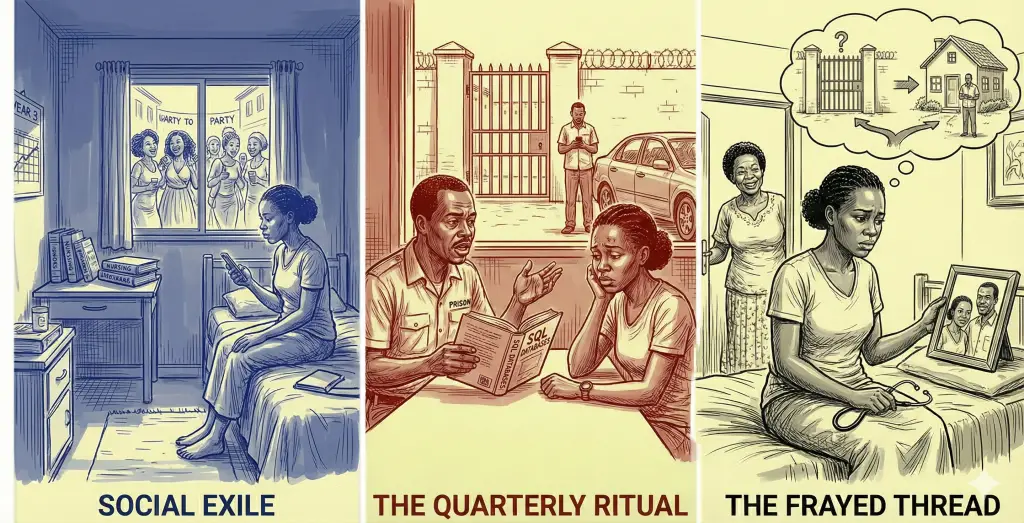
Gradually, Abena had created a “Social Exile”; she no longer attended social events. It had started with small excuses. If it were a nursing colleague’s wedding in Kasoa, she would say, “I have a double shift.” If it was an girls-girls party in Community 10, her default reply to the invitation was “I’m studying for my maternity boards.” But the truth was that social events had become a minefield. Abena couldn’t stand the way the atmosphere changed when she walked into a room. The conversations would dip, then resurface as a series of pitying smiles and invasive questions.
“How is he doing, Abena?” someone would whisper over a plate of party jollof. “Still twenty years? Ei, Nykopon mboa no (God help him). But my sister, you are still so young. Does it really make sense to wait for a man who is becoming a stranger?”
The whispers were worse than the silence. They made her feel like a museum exhibit of a tragic romance, a cautionary tale for other young women. By the middle of the fourth year in Tema, she stopped going entirely. She deleted her social media apps and changed her number, sharing the new one only with her parents, the hospital, and Osei.
Osei had become her only sanctuary. He was the only one who didn’t look at her with pity, mostly because he was the only one who didn’t treat Kwesi like a hero. He spoke of Kwesi with a practical, resigned sadness that mirrored Abena’s growing fatigue.
“People are cruel,” Osei said one Tuesday afternoon, leaning against the nurses’ station at the hospital. He had brought her a chilled bottle of Alvaro and a box of doughnuts. “They don’t understand that you have to live your own life. You can’t put your heart in a cell for two decades and expect it to still be beating when he comes out.”
Abena took a sip of the drink, the cold sweetness a momentary distraction. “The other nurses… they think I’m crazy, Osei. They talk behind my back about how I’m wasting my ‘prime.'”
“Forget them,” Osei said, his voice dropping into that intimate, protective register he had perfected. “They aren’t the ones driving to Kumasi every three months. They aren’t the ones holding the fort. You’ve done more than enough, Abena. You’ve been a saint. But even saints get tired.”
The quarterly visits were becoming a ritual of endurance. The five-hour drive felt like a journey to a different planet. When she saw Kwesi now, the conversation was strained. He talked about his computer lab, about SQL databases and criminology theories, his eyes burning with an intensity she could no longer relate to. He was becoming a creature of logic and forensics, while she was a woman longing for a quiet home and the sound of a child’s laughter.
“You look different, Abena,” Kwesi said during her one of her quarterly visits. He looked at her, his gaze searching her face for the woman who used to bring him joy and laughter.
“I’m just working hard, Kwesi,” she replied, her voice sounding flat even to her own ears. “The maternity ward is busy. So many babies.”
“Is Osei still looking after you?”
“He is,” she said, glancing toward the waiting room where Osei was chatting with a guard. “I don’t know what I would do without him. He’s the only friend I have left in Tema.”
Kwesi nodded, a flicker of doubt crossing his face, but he quickly masked it. He had to believe in Osei. He had to believe someone was guarding the only thing he had left.
As they walked out of the prison that day, Osei noticed her silence. He didn’t push. He simply opened the car door and let the AC hum to life. The journey back to Tema was spent mostly in silence. Osei could sense the tide changing in his favour; he would not force it, he would let the current bring it to him.
“I heard there’s a new spot in Community 11,” Osei mentioned casually as they entered Tema. “Great grilled tilapia. You haven’t eaten all day. Let’s stop there before I drop you off.”
Abena didn’t argue. The tilapia would be fresh, the music would be low, and for a few hours, she wouldn’t have to be the fiancée of Prisoner 4405. She would just be a woman having dinner with a man who was always, without fail, there.
The silence of her room in Community 4 had become a heavy, judgmental thing. That night, after the tilapia dinner, Abena lay in the dark, the whir of the table fan the only sound in the small space. She was twenty-nine years old now, nearly thirty. The milestone felt like a cliff edge.
She did the math again—the same math her father had done in the living room in Patasi last year. Sixteen years left.
She tried to conjure the memory of Kwesi in his white and blue kente, the man who had promised her a house and a life of joy. But that image was becoming translucent, a shadow of a man who no longer existed. The Kwesi she saw now was a man of cold logic, a man whose skin was grey from the lack of sun, a man whose heart was slowly hardening into a weapon. Did she even know him anymore? Did she want to be the woman who stood at the gates in sixteen years, welcoming home a stranger?
The guilt was a physical weight on her chest. She felt like a traitor for even thinking it. She remembered her vows, the letters she had written in the first year, the way she had screamed when the handcuffs clicked. But four years of silence and salt air had changed her. She was tired of being a symbol of loyalty. She was tired of the “social exile.” She just wanted to be a woman with a husband who didn’t live behind bars.
A soft knock at her door interrupted the spiral of her thoughts. It was Maame Efua.
“Abena? Are you awake?” the widow asked, stepping inside the room “Osei left this for you. He said you forgot it in the car.”
It was her stethoscope, a small but vital tool of her trade.
“He is a good man, that one,” Maame Efua said. “He worries for you. He tells me all the time, ‘Maame, make sure she eats. Make sure she rests.’ A man who looks after a woman when her house is on fire… that is a man worth keeping.”
Abena took the stethoscope, her fingers brushing against the cold metal. “He is my cousin, Maame.”
Maame Efua let out a soft, knowing laugh. “Blood is thick, my daughter, but presence is thicker. You are a nurse; you know that a body needs warmth to survive. You cannot warm yourself with a memory for twenty years.”
As Maame Efua left, Abena looked at the stethoscope. Osei hadn’t just returned a tool; he had sent a reminder. He was the one who knew her shift schedule. He was the one who ensured she had gas for her stove. He was the reality, and Kwesi was the dream that had turned into a nightmare.
She thought of their dinner at Community 11. Osei had laughed at her jokes. He had listened to her complaints about the senior matron. He had looked at her not with pity, but with a quiet, steady admiration. For a few hours, she had felt like a normal person. She had felt… alive.
The determination she had carried for four years was no longer a solid wall. It was a thread, frayed and thinning, being pulled by the weight of a life she was missing out on. She wasn’t ready to walk away from Kwesi yet—the memory of Kwesi was still too strong for that—but the temptation of the “easy” path, the path Osei was paving with envelopes and dinners and constant presence, was becoming a siren song she could no longer ignore. She fell asleep with a prayer for strength, but even as she prayed, she knew the erosion had reached the foundation.