Pages 87 & 88
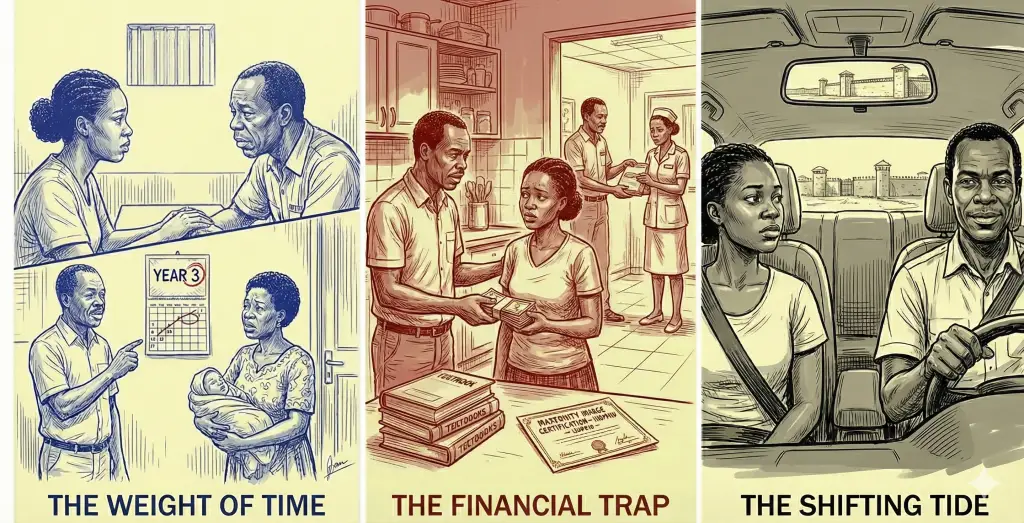
By the start of the third year of Kwesi’s sentence, the industrial salt of Tema seemed to have settled into Abena’s very bones. The sharp, agonising grief that had defined the first few months of Kwesi’s sentence had transitioned into something heavier and more permanent: a dull, rhythmic ache.
Life at the Tema Children’s Hospital was a relentless cycle of crying infants and overstretched resources. Abena had thrown herself into her work, seeking a specialised maternity nurse certification that demanded twelve-hour shifts and late-night study sessions. But the professional fulfilment was shadowed by a crushing financial reality. Due to the “administrative cleanup” mandated by the IMF program, the Ministry of Public Health had failed to upload the new cohort of nurses onto the payroll. For two years, Abena had worked for the state without receiving a single cedi in salary.
She had exhausted her meagre savings within the first six months.
“You are family, Abena. Please, stop talking about pride,” Osei said, standing in her small kitchen. He had arrived that evening with a thick envelope, just as he had every month for the past year.
“I can’t keep taking this, Osei,” Abena whispered, her eyes fixed on the envelope on the table. “I already owe you thousands. What if the back pay never comes?”
“Then it never comes,” Osei replied with a shrug that was perfectly tuned to look casual. “I have a good job. Kojo ensures the bonuses are frequent. What is a little money between siblings? Kwesi is my brother. If he were here, he would do the same for me.”
It was a masterful lie. Osei enjoyed the power the “loans” gave him. Each envelope was a brick in a wall he was building between Abena and her past.
But the financial debt was only half of the trap. To show her gratitude, Abena had begun a new routine. Every month, she would cook a large batch of groundnut soup or jollof rice, his favourites, for Osei to pick up. It started as a thank-you, but it quickly became a domestic anchor. Osei would linger in her doorway, the smell of her cooking filling the small room, talking about the “big man” meetings he had at the harbour.
There were also visits to the hospital at least twice a week. “I was just driving past the hospital for a meeting,” Osei would say, popping into the ward with a cold malt or a meat pie. “Just wanted to see if you were surviving the shift.”
To the other nurses, Osei was the perfect cousin, a successful, attentive man who looked after his family. To Abena, he was the only bridge to the world outside her exhaustion.
The most significant change, however, was the calendar. In the first two years, Abena had been religious about the first Saturday of the month. She would brave the five-hour road ride to Kumasi, her heart racing as she approached the ACP gates. But the new specialisation course was demanding. The textbooks were thick, and the exams were unforgiving.
By the middle of Kwesi’s third year, the monthly visits became every other month.
“Kwesi understands,” Osei would murmur as they drove toward Kumasi in his car, a car he now insisted on using for every trip. “He wants you to be a specialist. He told me himself: ‘Osei, tell her to focus on her books. Don’t let her waste her life.'”
Abena would nod, leaning her head against the window, too tired to wonder if Kwesi had actually said those words. Each skipped month felt like a small betrayal, but the physical and mental fatigue was a tide she could no longer swim against. The “Golden Boy” was still in his cell, but in the humid, salt-stained air of Tema, his image was starting to blur, gradually being replaced by the steady, smiling presence of the man who never missed a week without seeing her.
After one of her Saturday visits to Kwesi in his third year at ACP, Abena visited her parents at Patasi. Her father, Mr. Ofori, was cleaning his spectacles with a cloth, while her mother sat opposite her, shelling garden eggs into a plastic bowl. The peach-colored walls of the house, once a symbol of her bright future, now felt like a gallery of things that might have been.
“Abena,” her mother began, her voice unusually soft. She set the bowl aside and looked at her daughter. “We have kept silent for three years because we know your heart. But a mother who sees a pit in her daughter’s path and says nothing is not a mother.”
Abena felt a familiar tightening in her chest. “Ma, please. If this is about Kwesi—”
“It is about you,” her father interrupted, his tone carrying the weight of his years as a headmaster. “Look at the math, Abena. You are twenty-eight years old. Kwesi has seventeen years left. By the time he walks out of those gates, you will be forty-five. Do you understand what that means?”
“I know how to count, Papa,” Abena said, her voice rising.
“Then count the children you will never have,” Mr. Ofori said firmly. “Count the years your mother and I have left. We are not getting younger. I want to see my grandchildren. I want to see you in a home that isn’t a rented outbuilding in Community 4. I want to see you protected by a man who can actually stand beside you.”
Abena looked at her hands, the same hands that had just pressed against those of Kwesi a few hours ago. “He is innocent, Papa. Lawyer Kwarteng is still—”
“Lawyer Kwarteng has postponed the fight ,” her mother sighed. “Three years, Abena. No new evidence. No retrial. The world has moved on. Even Kwesi’s father has accepted the quiet of Ejisu. Why are you the only one still standing in the rain?”
Mrs. Ofori reached out and took Abena’s hand. “Osei is a good man. He has been there for you when the Ministry failed you. He takes you to the prison. He looks after us when he comes to Kumasi. He has a stable job, a future. He respects you, Abena.”
“Osei is a cousin,” Abena whispered, though the word felt thin.
“He is a man who loves you,” her father corrected. “And unlike Kwesi, he is here. Life is for the living, my daughter. Don’t let your youth become a sacrifice for a mistake that wasn’t yours.”
The conversation ended there, but the silence that followed was louder than the argument. That night, lying in her old bed, Abena couldn’t sleep. Her parents’ words were like salt on a fresh wound. She thought of the maternity ward in Tema, the joy of the mothers she helped, the weight of the newborns in her arms. She wanted that. She wanted a life that didn’t involve a visitation schedule.
As she prepared to return to Tema the next morning, she looked at the framed photo of her and Kwesi on the dresser. They were both laughing, the sun caught in their eyes. For the first time, she didn’t see a promise in that photo; she saw a tragedy.
Osei was waiting at the gate in his Ford, his arm resting casually out the window. He smiled as he saw her, a warm, patient expression that didn’t demand anything but her presence. As she climbed into the passenger seat, the smell of his expensive cologne replaced the lingering scent of the prison.
“Everything okay?” Osei asked, checking his mirrors.
“Just tired,” Abena replied, leaning back and closing her eyes.
“Rest,” Osei said softly, reaching over to briefly squeeze her shoulder. “It’s a long drive. I’ll get you home.”
Home. The word sounded different now. It was no longer a destination shared with Kwesi; it was a quiet outbuilding in Tema, where the porch light was kept on by a widow, and the groceries were paid for by a man who was always there. The erosion was no longer a slow drip; it was becoming a landslide.