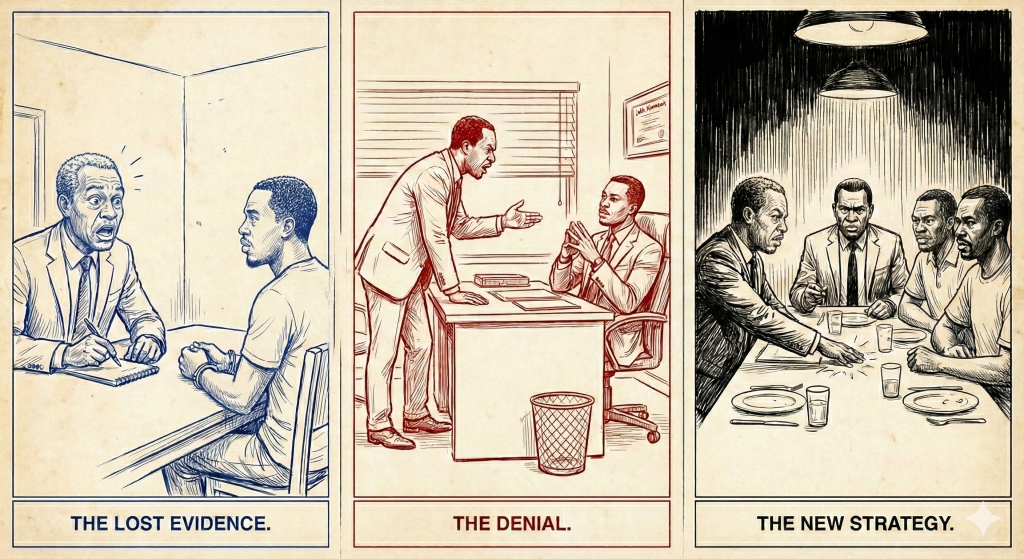
Later that afternoon, after the dust had settled in the yard of the Ashanti Cocoa Company, Kwesi was once more led to the interrogation room. This time, the visitor was not a prosecutor with cold eyes, but rather Lawyer Kwarteng.
The lawyer had started his morning with a meeting with his private investigator, who was convinced that if anyone was orchestrating a frame-up, it was Kojo, the accountant. Armed with this theory, Kwarteng sat down opposite Kwesi.
“How are you holding up, my son?” Kwarteng asked, arranging his notepad.
“Better, Lawyer. Much better,” Kwesi said, a strange lightness in his voice. He spoke of Abena’s visit, how her presence had given him strength. “And then, Mr Asamoah came.”
“The Prosecutor?” Kwarteng looked up sharply. “Did he question you without me present?”
“It is fine, Lawyer,” Kwesi smiled, a look of naive triumph on his face. “I told him everything. I told him he was looking for a thief, but I was the one catching the thieves. I told him about the Shadow Ledger.”
Kwarteng froze, his pen hovering over the paper. “The… what?”
“The ledger. The notebook where I recorded the truck numbers, the dates, the diverted tonnage. I hid it in my office. I told Mr Asamoah exactly where to find it. He went to get it. Once he sees those figures, this fabrication will be over. He is a man of the law; he will see the truth.”
Lawyer Kwarteng felt a cold pit form in his stomach. He saw the situation with terrifying clarity. Kwesi’s good heart had led him to make a fatal error. You do not hand the only weapon you have to the man trying to execute you.
“Kwesi,” Kwarteng said, his voice urgent, “pray that he is indeed a man of the law.”
He immediately pulled out his phone and dialled Mr Mensah. “Mensah, drop everything. Run to Kwesi’s office. Check the false bottom in the filing cabinet. Secure a black notebook. Now!”
Ten minutes of agonising silence ticked by. Kwesi watched his lawyer’s face transform from concern to grim resignation. The phone rang.
“It’s gone, Lawyer,” Mensah’s breathless voice crackled through the speaker. “The cabinet is empty. I asked the security guard. He said a man in a dark suit came in about an hour ago, flashed a badge, went straight to the office, and left without speaking to anyone.”
Kwarteng ended the call. He looked at Kwesi, who was watching him with wide, confused eyes.
“The ledger is gone, Kwesi. The prosecutor took it.”
“That is good, no?” Kwesi asked, his voice wavering. “He has the evidence.”
“Or he has destroyed it,” Kwarteng said bluntly. “Kwesi, listen to me. We need to reconstruct that ledger. Right now. Give me the names. The truck registration numbers. The dates. Tell me what was in that book.”
For the next thirty minutes, Kwarteng tried to extract the data from Kwesi’s memory. But the trauma of the arrest, the sleepless nights in the cell, and the shock of the betrayal had fogged Kwesi’s mind. He could remember the broad strokes—the late-night loadings, the heavy sacks—but the specifics? The alphanumeric licence plates that would link the trucks to Asamoah Snr? They were a blur.
“I… I can’t remember the exact numbers,” Kwesi stammered, panic rising in his chest. “That is why I wrote them down. I thought they were safe.”
Kwarteng closed his notepad. “It is alright. We will find another way.”
He left the station, his engine revving hard as he drove straight to the Attorney General’s Department. He didn’t wait to be announced. He marched past the secretary and pushed open the door to Jude Asamoah’s office.
Jude looked up, his face impassive, though his eyes darted to the wastebasket.
“Barrister Kwarteng,” Jude said coolly. “To what do I owe the pleasure?”
“I am here to remind you of Article 19 of the 1992 Constitution,” Kwarteng said, his voice booming. “The prosecution is obligated to disclose all evidence to the defence to ensure a fair trial. I am demanding the notebook you retrieved from my client’s office this morning.”
Jude didn’t blink. He leaned back in his chair, steepling his fingers. “A notebook? I’m afraid I don’t know what you are talking about, Counsel. Yes, I visited the accused to clarify his statement. He was rambling, incoherent. He mentioned a ledger; I went to his office and checked the cabinet, but I found no ledger.”
“My client says—”
“Your client is a desperate man facing a long prison sentence,” Jude cut in smoothly. “If such a ledger existed, why didn’t he produce it earlier? Perhaps it is a figment of his imagination. Or perhaps,” Jude’s eyes glittered dangerously, “it never existed at all.”
Kwarteng stared at him. He saw the slight tremor in Jude’s hand, the faint smell of smoke in the room. He knew. But without the book, it was his word against the State Prosecutor’s.
“Be careful, Asamoah,” Kwarteng warned softly. “You are playing a dangerous game. The truth has a way of rising.”
He turned and walked out, leaving Jude alone with his guilt.
At 6:00 pm, Kwarteng convened a council of war at a small restaurant in Adum. Mr Mensah, Uncle Gyasi, and Mr Ofori sat around the table, their faces grave as Kwarteng recounted the encounter.
“He denied it,” Kwarteng told them. “He claims he never saw the ledger. Our smoking gun is gone.”
Mr Ofori groaned, burying his face in his hands. “My poor boy. What do we do?”
“We fight,” Kwarteng said, slamming his hand on the table. “In court, cases are won by evidence and facts. Jude may have stolen our best evidence because it scared him. That means it pointed to something—or someone—he does not want us to know about. We must find what was in that book.”
“Kwesi couldn’t remember the numbers,” Uncle Gyasi said sadly.
“I can help with that,” Mr Mensah said, his jaw set with determination. “I am still the manager. I have access to the archives. Kojo is clever, but he is arrogant. He might have left a digital footprint, a duplicate waybill, or a security log entry. I will dig until my fingers bleed.”
“And I,” Uncle Gyasi said, standing up, “I will go to Tema. I know the drivers there. I know the unions. If Kwesi said they were diverting cocoa, those trucks went somewhere. I will find out who owns them.”
“Good,” Kwarteng nodded. “We have a Herculean task on our shoulders, gentlemen. But we are not just fighting for Kwesi’s freedom anymore. We are fighting against a rot that goes deep. And we will cut it out.”
The men departed into the gathering dusk, the weight of the injustice heavy on their shoulders, but their resolve stronger than ever.