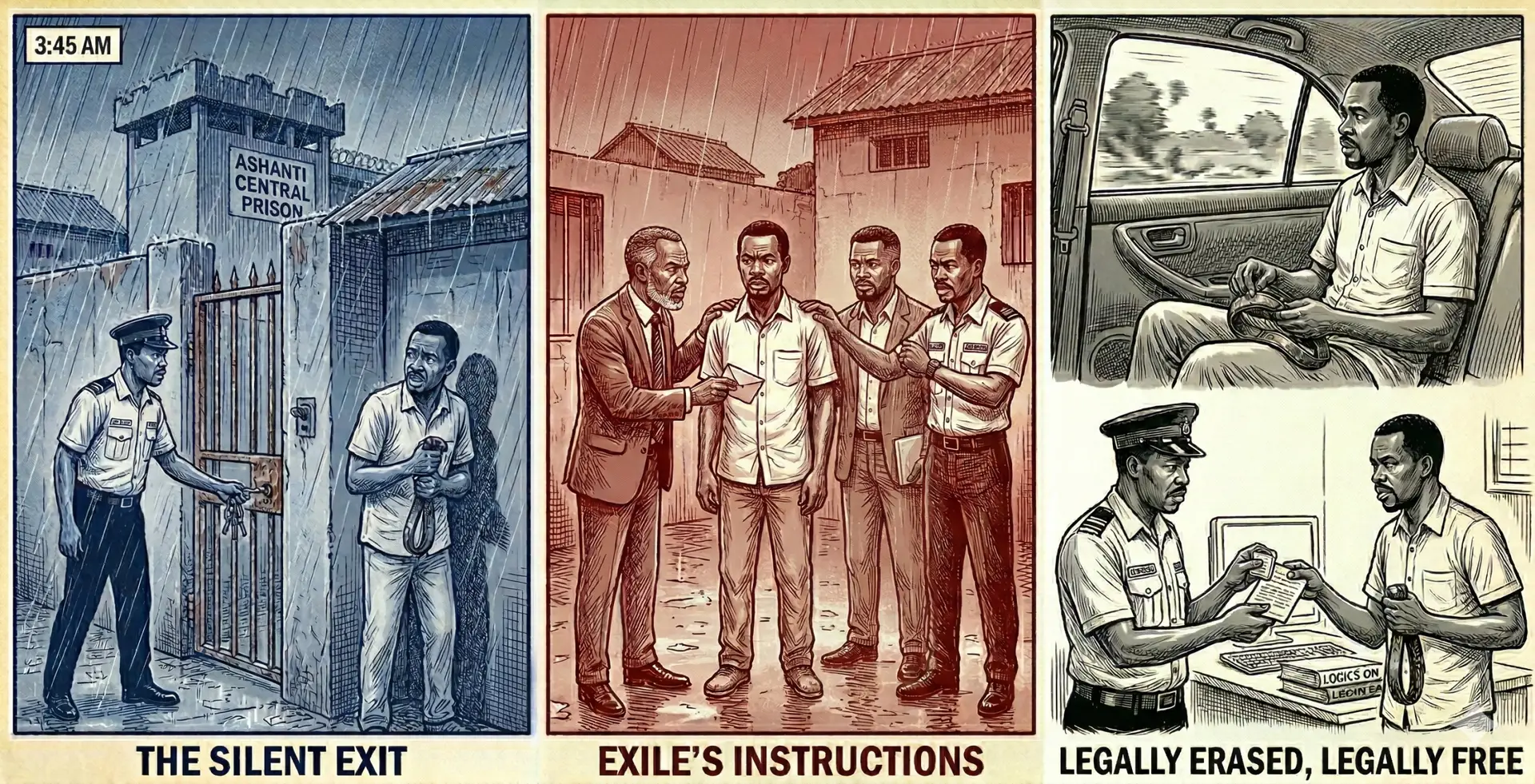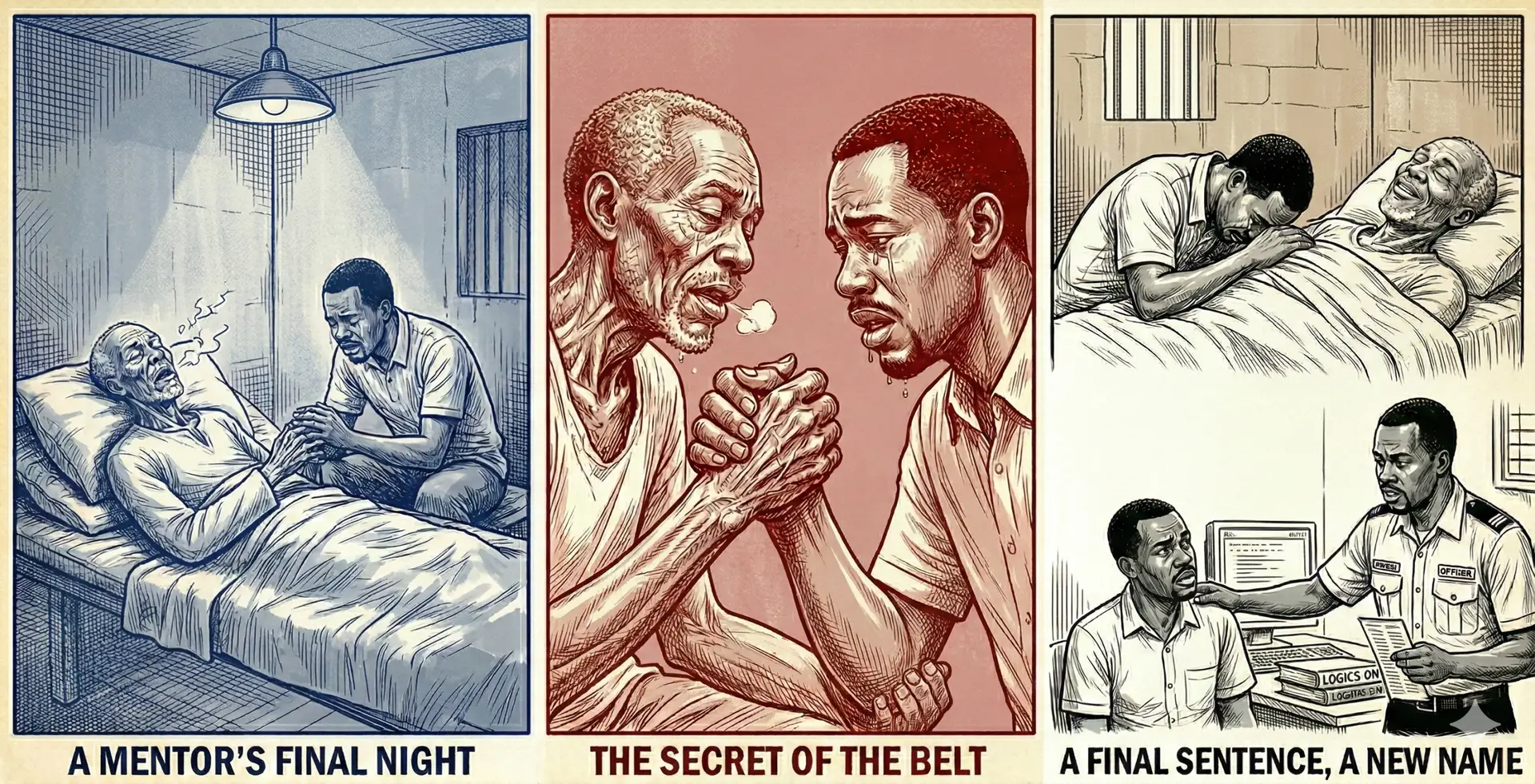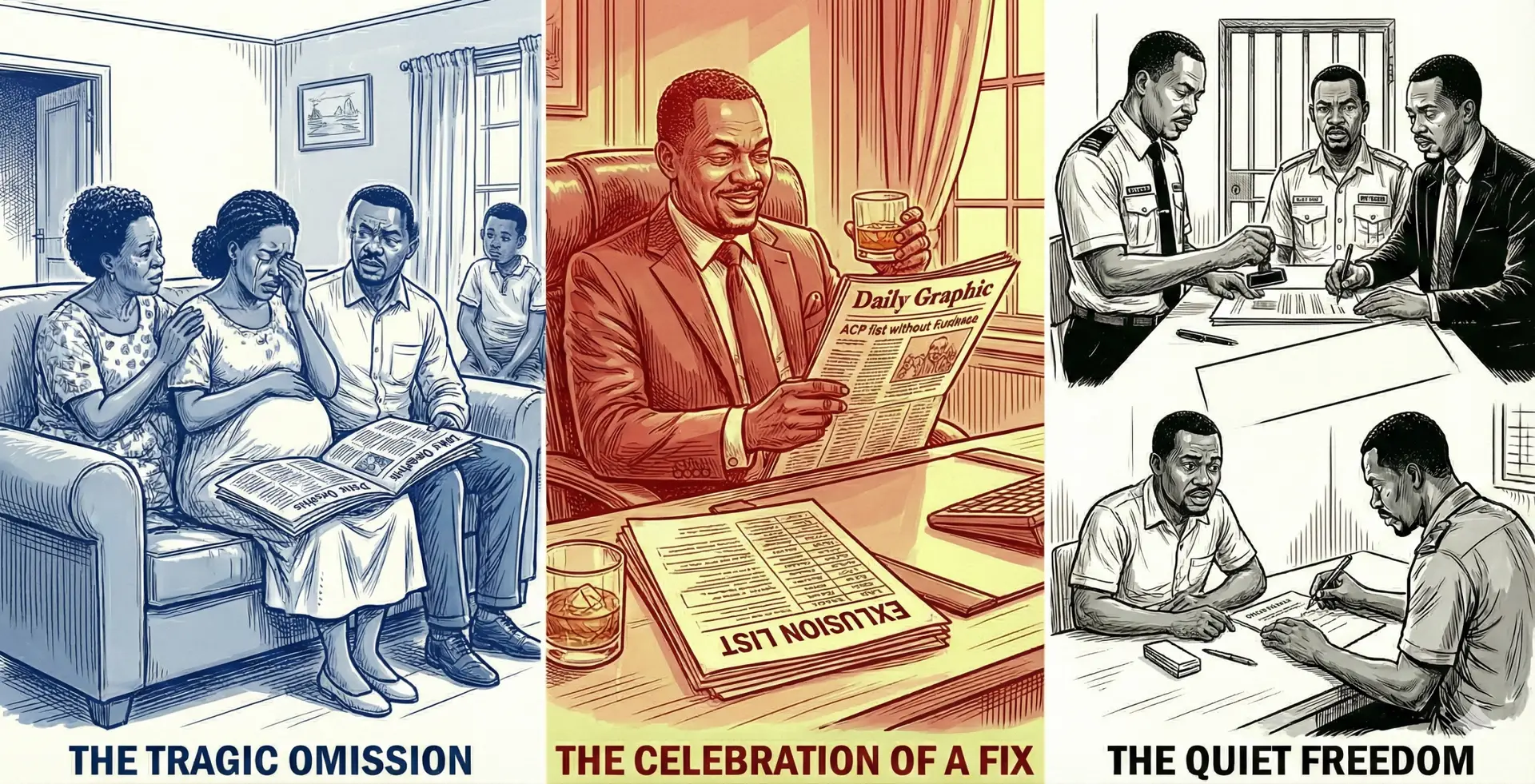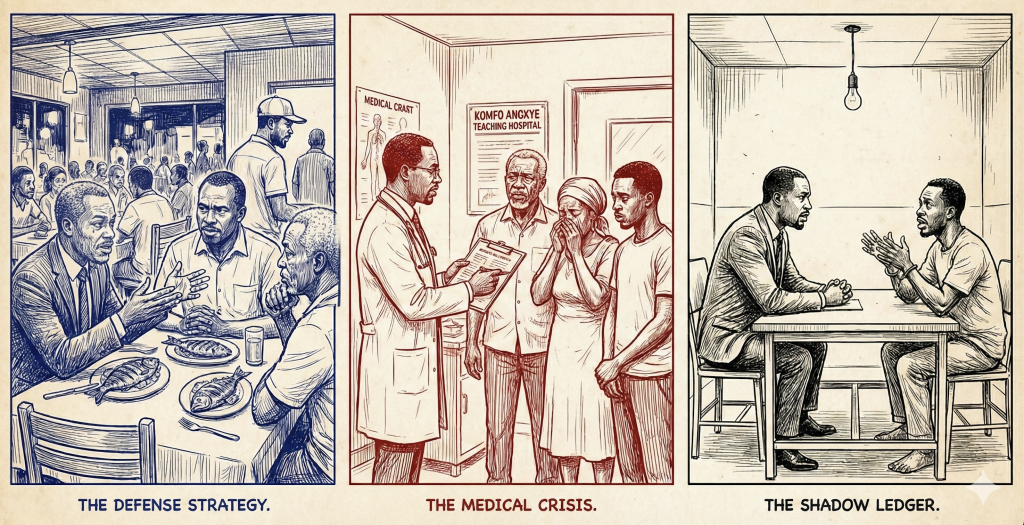
While Jude was being chauffeured to the affluent neighbourhood of Nhyiaeso for dinner with Justice Boateng, a very different kind of meeting was taking place in a quiet, dimly lit restaurant in Adum. The air smelled of grilled tilapia and spicy kebabs, a stark contrast to the refined aromas of the Boateng residence.
Lawyer Kwarteng sat at a corner table with Mr. Mensah and Uncle Gyasi. He had just come from a brief, hushed conversation with a man in a faded baseball cap, his private investigator, who had been tasked with digging into the anomalies of the case.
“The preliminary findings are… interesting,” Kwarteng said, leaning in. “My man tells me there’s a pattern with the trucks involved in these so-called missing shipments. They don’t just vanish. They take a detour.”
Mr. Mensah nodded vigorously. “I knew it! I’ve been saying Kojo’s books don’t add up. The weights he records at the depot versus what arrives at the port, there’s always a discrepancy, but it’s just small enough to be written off as ‘shrinkage’ or moisture loss. But over time? It’s tons of cocoa.”
“My nephew is honest to a fault,” Uncle Gyasi added, his voice trembling with emotion. “He would never steal. He lived on practically nothing just to pay his student loan and pay for his father’s debt. Why would he steal now, when he has everything?”
“That is exactly what we will prove,” Kwarteng assured them. “But we need more than character witnesses. We need hard evidence. Mr. Mensah, I need you to get me the shift logs for the security guards at the depot. And Uncle Gyasi, keep the family calm. We are building a case.”
Meanwhile, at the Boateng residence, the atmosphere was one of understated power. The house was a modern mansion, with marble floors, mahogany furniture, and African art that whispered rather than shouted wealth.
Jude sat across from Cynthia, whose smile was the only thing that relaxed the knot in his stomach. At the head of the table sat Justice Boateng, a man who carved his meat with the same precision he used to dissect legal arguments.
“The Dankwa case,” the Judge said, not looking up from his plate. “It’s making quite the noise on the radio.”
Jude straightened, wiping his mouth with a linen napkin. “Yes, sir. It’s a significant case. Public interest is high.”
“Public interest is fickle,” the Judge retorted, finally fixing his gaze on Jude. “The law is what matters. And the integrity of those who uphold it. Is the case solid?”
“We have strong circumstantial evidence, sir. The police report is detailed.”
“Circumstantial,” the Judge mused, testing the word. “A dangerous foundation to build a house on, Jude. Especially when the accused has a clean record and a lawyer like Kwarteng in his corner. Don’t let ambition cloud your diligence. A conviction must be beyond reasonable doubt, not just beyond public doubt.”
“I understand, sir. I intend to interrogate the accused personally tomorrow to solidify our position.”
“Good,” the Judge nodded, signalling the end of the interrogation. “Cynthia tells me the wedding preparations are advancing. I want no shadows over this union, Jude. You know that.”
“I know, sir. There will be none.”
The drive home was quiet. The Judge’s warning echoed in Jude’s mind. No shadows. He needed this conviction to be clean, irrefutable. He needed Kwesi Dankwa to confess.
Tuesday morning found Jude in the interrogation room at the Sofoline Police Station. The room was stark, smelling of old sweat and floor cleaner. Kwesi sat on the other side of the metal table, hands cuffed. He looked tired, but his eyes were clear, devoid of the guilt Jude usually saw in criminals.
Jude opened the file. “Mr. Dankwa, let’s make this simple. We have the anonymous tip-off. We have the discrepancies in the shipping manifests. We know about the sudden wealth. The expensive kente cloths, the bank accounts, the cars, the houses, the money you threw at your father’s debtors. It all points to one thing: you were selling company cocoa.”
Kwesi shook his head slowly. “Sir, I rented the kente. I don’t own a car, the cars for the knocking ceremony were rented taxis. I don’t own a single building. All I have is a plot of land. The money for my father…it was my per diem saved over the last year. I am not a thief.”
“Then explain the missing cocoa. Tons of it, diverted from the Tema route.”
“I can explain it,” Kwesi said, his voice gaining strength. “I found it too. That’s why I was tracking it. I knew someone was bleeding the depot. I suspected the accounts department, but I needed proof.”
Jude paused. This wasn’t the desperate rambling of a guilty man. This was specific. “Proof? What proof?”
“I kept a log,” Kwesi said, leaning forward. “A private ledger. Every time a truck left the depot off-schedule, or with weight discrepancies, I noted it down. Truck numbers, driver names, times. I called it my Shadow Ledger.”
Jude’s eyes narrowed. “Where is this ledger?”
“I hid it,” Kwesi said. “In the false bottom of the file cabinet in my office. The bottom drawer, at the back. If you get that book, sir, you will see I wasn’t stealing the cocoa. I was building a case to stop it.”
Kwesi looked at Jude with desperate hope. “Please, sir. Go get it. It will prove my innocence.”
Unknown to Kwesi, he had just made the biggest mistake in his life.
After Jude left, visibly unsettled but with a new direction, the door opened again. This time, it wasn’t a prosecutor, but family. Abena, Mr. Ofori, and Mrs. Ofori entered, escorted by a sympathetic female officer who granted them five minutes.
“Kwesi!” Abena cried, rushing to the table but stopping short of the handcuffs. She reached out and covered his hands with hers. “Oh, look at you.”
“I am fine, Abena. I am fine,” Kwesi lied, trying to smile. “Don’t cry, please. It breaks my heart.”
“We are praying, son,” Mr. Ofori said, his voice thick with emotion. “The whole family is praying.”
“How is Papa?” Kwesi asked, his eyes darting between them. “Is he…?”
Mr. Ofori hesitated for a fraction of a second. “He is still in the hospital, Kwesi. But he is getting better. The doctors are doing their best.”
It was a kindness, a half-truth to spare the prisoner more pain.
“I told the Prosecutor everything,” Kwesi said, a spark of hope in his eyes. “I told him about my ledger. Once he sees it, once he sees the truth, this will all be over. He is a man of the law. He will see.”
“God grant it be so,” Mrs. Ofori whispered.
“Time is up,” the officer said gently.
As the Oforis left the station, burdened with a mix of hope and sorrow, another drama was unfolding at the Komfo Anokye Teaching Hospital.
Uncle Gyasi stood in the corridor, phone pressed to his ear. “Osei? Come to the hospital now. Bring your aunties. The doctor has news.”
Thirty minutes later, Osei arrived, looking appropriately sombre, though his mind was calculating the angles. He joined his aunties and Uncle Gyasi in the doctor’s small office.
“Opanyin Dankwa’s condition is critical,” the specialist said, getting straight to the point. “The stroke has caused significant swelling. Standard treatment isn’t responding as we’d hoped. However…” He paused, looking at the anxious faces. “There is a new experimental drug being trialled at the Noguchi Memorial Institute in Accra. It has shown remarkable results in reducing this specific type of swelling and restoring function.”
“Then give it to him!” Auntie Yaa cried. “Please, doctor!”
“It is not that simple,” the doctor sighed. “It is not covered by insurance. It is very expensive to procure and administer. The full course of treatment costs 300,000 Ghana Cedis.”
The room went silent. 300,000 Ghana Cedis. It was a fortune.
“We will find the money,” Uncle Gyasi said, his voice trembling but determined. “We have to.”