Note: I have changed the name of the state prosecutor from Justice Asamoah to Jude Asamoah.
The Sunday sun rose over Kumasi, indifferent to the turmoil brewing below. While many devout Christians were heading to their places of worship across the city, a different kind of devotion was taking place in the quiet, air-conditioned office of the State Prosecutor.
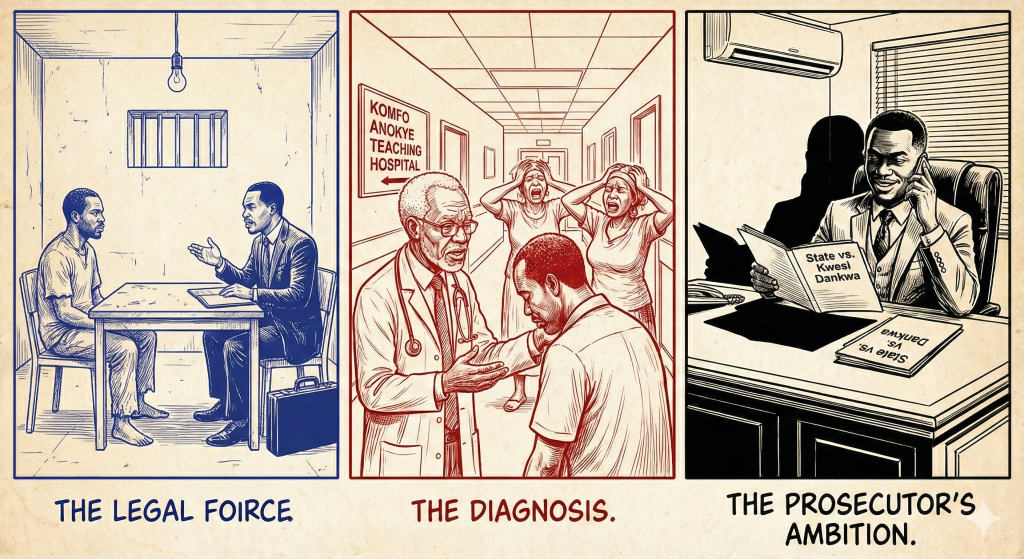
Jude Asamoah sat behind his large mahogany desk, the file labelled “State vs. Kwesi Dankwa” open before him. He was a man who wore his ambition like a second skin, tailored and sharp. He adjusted his glasses, scanning the reports submitted by the investigators Chief Inspector Amidu had deployed. It was all there: the altered manifests, the “anonymous” witness statements, the bank records showing large, unexplained deposits. It was a masterpiece of fabrication, though Asamoah didn’t know that—or perhaps, in his zeal for a career-defining case, he chose not to look too closely at the cracks.
He picked up his phone and dialled a number. “Inspector? Yes, Asamoah here. I have the preliminary reports. Excellent work. I need the final forensic audit on my desk by 6 AM tomorrow. No excuses. I want this docket bulletproof before I walk into court. We are going to make an example of this one.”
He hung up, a satisfied smile playing on his lips. This case was his ticket to Accra.
Across town, in the more modest but dignified office of Lawyer Kwarteng in Adum, a council of war was convening. Mr. Mensah, looking weary but resolute, sat alongside Mr. Ofori and Uncle Gyasi.
Lawyer Kwarteng, a man known for his sharp mind and even sharper suits, listened intently as Mr. Mensah laid out the facts: the promotion, the integrity of Kwesi, the suddenness of the accusations.
“It smells,” Kwarteng said finally, leaning back in his leather chair. “It smells of a setup. But in law, smell isn’t evidence. We need facts. I will take the case.”
“Thank you,” Mr. Ofori breathed, relief washing over him.
“But be warned,” Lawyer Kwarteng added, his voice grave. “The charges are severe. Non-bailable offences, usually. Getting him out tomorrow will be a battle, not a formality. But I will fight. Meet me at the station this evening. I need to see my client.”
While the men plotted legal strategies, the women fought their own battles on the home front. At the Ofori residence, Abena and her mother moved around the kitchen in a silent, coordinated dance, preparing food not for a celebration, but for a prisoner. The aroma of boiled yam and palava sauce filled the air, a cruel reminder of the joy that should have been.
At 4 PM sharp, a taxi pulled up. Osei stepped out, looking solemn in a dark shirt and trousers. He greeted Mrs. Ofori with exaggerated respect.
“I am here for Abena,” he said softly. “I didn’t want her to go alone.”
Mrs. Ofori nodded, grateful. “You are a good cousin, Osei. God bless you.”
Osei suppressed a smirk. If only she knew. His motive wasn’t charity; it was opportunity. Every minute spent with Abena was a minute he could chip away at her faith in Kwesi and build a foundation for himself.
As they prepared to leave, Mrs. Ofori’s phone rang. It was Auntie Yaa.
“We are going to Komfo Anokye,” Auntie Yaa’s voice crackled over the line. “We cooked some light soup for Opanyin. He needs his strength.”
“I will meet you there,” Mrs. Ofori decided instantly. The family was dividing its forces, one flank to the prison, the other to the hospital.
At the Sofoline Police Station, the evening air was thick with humidity and tension. The lawyer’s Mercedes pulled in just as Osei and Abena arrived in their taxi.
Lawyer Kwarteng wasted no time. He marched to the front desk, his authority radiating like heat. “I am Lawyer Kwarteng, I am representing Mr. Kwesi Dankwa. I demand to see my client immediately.”
The sergeant, intimidated by the suit and the lawyer’s reputation, nodded quickly. “Yes, sir. This way.”
“We are family,” Abena said, stepping forward, clutching the food cooler. “Can we see him too?”
The sergeant shook his head firmly. “Counsel only. Strict orders from the top. You can leave the food.”
Abena’s face crumbled. She turned to the lawyer, eyes pleading. “Tell him… tell him we are here. Tell him I love him.”
“I will,” Kwarteng promised gently.
Abena sank onto a bench in the waiting area, burying her face in her hands. Osei sat beside her, wrapping a comforting arm around her shoulders. “It is okay,” he whispered, his voice smooth. “The system is hard. But I am here.”
Inside the interrogation room, Kwesi looked up as the lawyer entered. He looked haggard, his eyes hollowed by sleeplessness and shock.
“Mr. Dankwa, I am Lawyer Kwarteng. Mr. Mensah sent me.”
For the next hour, Kwesi poured out his story. He explained the logistics, the discrepancies he had found, his suspicions about Kojo. Kwarteng took copious notes, his frown deepening.
“They have built a cage around you, Kwesi,” the lawyer said finally. “But cages have keys. I am going to speak to the Chief Inspector now. I want to see the charge sheet. If they hold you past 48 hours without charge, I will file for Habeas Corpus immediately. I will try and get you bail tomorrow.”
He left Kwesi with a glimmer of hope and marched into Chief Inspector Amidu’s office. The confrontation was polite but icy. Kwarteng demanded specifics; Amidu provided vague assurances of “ongoing investigations.” Kwarteng left with a warning: “My client is innocent until proven guilty, Chief Inspector. Do not let your zeal outpace the law.”
While the legal battle raged, a different kind of struggle was happening at the Komfo Anokye Teaching Hospital. Mrs. Ofori, Auntie Yaa, and Auntie Esi sat in the wooden chairs of the waiting area, the cooler of soup growing cold at their feet. They had been waiting for over an hour.
“Why won’t they let us in?” Auntie Esi fretted, wringing her hands.
“They say we must wait for the doctor,” Auntie Yaa replied, frustration mounting. “But where is he?”
Auntie Esi pulled out her phone and called Uncle Gyasi. “Gyasi, you must come. Something is wrong. They are keeping us waiting too long.”
“I will come with Osei,” Uncle Gyasi assured her.
Back at the station, Lawyer Kwarteng emerged. He spoke to Abena and Mr. Ofori, his voice projecting confidence he hoped would catch. “I have spoken to him. He is strong. We will fight this. Go home, rest. We need you strong for court tomorrow.”
Abena nodded, wiping her tears. “Thank you, sir.”
Mr. Ofori and Abena left, a fragile hope kindled in their hearts. Mr. Mensah and the lawyer departed soon after.
Uncle Gyasi turned to Osei. “Come with me to the hospital. Your aunts are worried.”
Osei’s heart skipped a beat. He didn’t want to go to the hospital. He wanted to go to the Blue Kiosk, to report to Kojo. But he couldn’t refuse. “Yes, Uncle.”
As they drove, Osei hastily typed a text under the dashboard, sending it to the group chat with Kojo and Agyeman: Lawyer is involved. Kwarteng. He is good. But Kwesi is still inside. Going to hospital now.
They arrived at Komfo Anokye to find the women pacing. The tension was palpable. Thirty minutes later, an elderly doctor in a white coat approached them, his expression grave.
“Family of Opanyin Dankwa?”
“Yes,” Uncle Gyasi stepped forward. “How is he?”
The doctor sighed, taking off his glasses. “I am sorry to have kept you waiting. We were running tests. It is… not good news.”
The women gasped.
“He has suffered a massive stroke,” the doctor said gently. “It affected the left hemisphere of his brain. He is in a coma right now. He will likely survive, but the damage is extensive. Even if he wakes up, he will be paralysed on his right side. His speech may never return.”
A wail went up from Auntie Yaa, a sound of pure anguish that echoed down the sterile corridor.
Throughout the night, the city of Kumasi slept fitfully. In his office, Jude Asamoah polished his opening statement, dreaming of headlines. In his study, Lawyer Kwarteng drafted bail applications, searching for a loophole. And in Cell 4, Kwesi stared at the ceiling, unaware that while he fought for his freedom, his father was fighting for his life, and the silence between them might now be forever.