“What are you suggesting, Accountant?” Osei asked.
“Kwesi is flying high right now. But a bird that flies too high is easy to shoot down. Especially if you know its flight path.” Kojo replied.
“And you know his flight path,” Agyeman said, more a statement than a question.
“I know every invoice, every waybill, every signature that crosses his desk,” Kojo said, a smug smile playing on his lips. “I know the shipments from Tema. I know the weights, the dates, the drivers. It would be… unfortunate… if some of those records were to tell a different story. A story of missing sacks, of diverted funds, of a young, ambitious man getting greedy.”
Osei took a long pull of his beer. The idea was intoxicating, more so than the alcohol. To see Kwesi brought low. To see the Golden Boy tarnished. To stop him from taking Abena.
“And the letter?” Osei asked. “You mentioned a letter.”
“An anonymous tip-off,” Kojo explained. “To the authorities. To the prosecutor. Justice Asamoah is a man looking for a big case to make his name. A case involving corruption at the Ashanti Cocoa Buying Company? That’s a career-maker.”
“But it has to be believable,” Agyeman interjected, his merchant’s mind already calculating the risks. “It can’t just be vague accusations. It needs details. Names, dates.”
“That is where you come in, my friend,” Kojo said, nodding at Osei. “You know his personal life. You know his movements. You know about the sudden wealth, the money he threw around Bantama. You can add the… colour. The arrogance. The lavish spending that doesn’t match a manager’s salary.”
Osei thought about the scene at the family house. The new clothes, the food, and the money given to Opanyin Dankwa. It was all true, in a way. Kwesi was spending money he hadn’t fully earned yet, banking on a promotion that hadn’t happened.
“I can do that,” Osei said, his voice steady. “I can tell them about the cars he hired. The new Kente. The way he acts like a chief.”
“Perfect,” Kojo said. He reached into his briefcase and pulled out a notepad and a pen. “We write it now. Tonight. By tomorrow morning, it will be on Asamoah’s desk. We can’t wait for the Board meeting on Monday. By then, he will be Regional Director.”
Osei’s eyes narrowed. “So when do they take him?”
Kojo smiled, a cold, thin expression. “When is he most vulnerable? When will it hurt the most?”
“The ceremony tomorrow,” Osei said, a cruel light igniting in his eyes. “The Knocking. Everyone will be there. His father. Senior members of our family, Abena’s family. The whole neighbourhood.”
“Exactly,” Kojo nodded, uncapping his pen. “Let him have his moment of joy. Let him climb to the very top of the mountain. The police will be waiting to drag him down.”
“It will be a spectacle,” Agyeman muttered, a nervous thrill in his voice. “The whole of Patasi will see it. And the whole Bantama will hear about it”
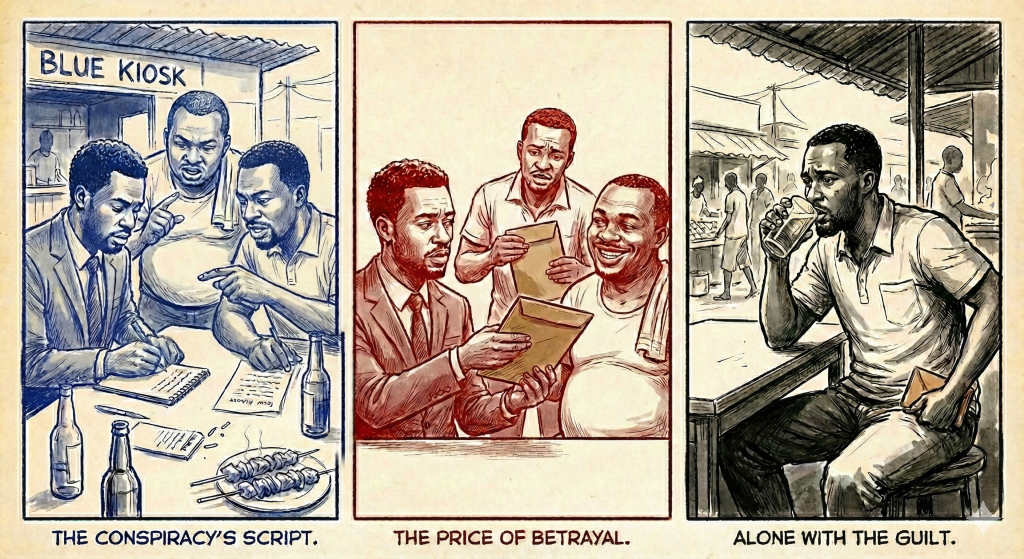
And so, huddled over a plastic table sticky with spilled beer, amidst the smoke of kebabs and the rhythm of a Daddy Lumba’s Highlife song, the three conspirators began to draft the document that would destroy a man’s life. Kojo provided the technical details, the specific shipment numbers, and the discrepancies he would fabricate in the ledger. Agyeman added the local gossip, the witness accounts of Kwesi’s “suspicious” spending. And Osei… Osei poured his jealousy onto the page, twisting Kwesi’s generosity into evidence of guilt, his ambition into proof of greed.
“Make sure you mention the knocking ceremony,” Osei said, his finger stabbing the paper. “Say he was in a rush. Say he was trying to spend the money fast before he got caught. Say he was buying a wife with stolen money.”
Kojo wrote it all down, using his left hand to conceal his real handwriting. Even with his less dominant hand, the handwriting was neat and precise, a stark contrast to the ugliness of the words. When they were finished, he read it back to them. It was a masterpiece of lies woven with threads of truth, a damning portrait of a young criminal mastermind.
“It is done,” Kojo said, folding the paper and sliding it into an envelope. He looked at his companions. “This stays between us. To the grave.”
“To the grave,” Agyeman echoed, though his eyes were darting nervously. “But… Kojo. This is dangerous work. If Kwesi comes back…”
“He won’t come back,” Kojo assured him. He reached into his briefcase again. This time, he didn’t pull out paper. He pulled out two thick brown envelopes.
He slid one across the sticky table to Agyeman, and the other to Osei.
Agyeman grabbed his envelope with trembling hands. He peered inside, and his breath hitched. It was a stack of one-hundred-cedi notes, thick enough to choke a goat.
“For your trouble,” Kojo said smoothly. “And for your silence. Consider it a down payment on the future. With Kwesi out of the way, I control the books. There will be opportunities for a friendly shopkeeper who wants to go into the importation of goods without heavy duties.”
Agyeman’s nervousness vanished, replaced by pure, unadulterated greed. He tucked the envelope deep into his pocket, patting it affectionately. “Kwesi was arrogant,” Agyeman rationalised quickly. “He treated us like peasants. He deserves what is coming.”
Osei stared at his envelope. It was heavy. Heavier than any paycheck he had ever earned. He picked it up, weighing it in his hand.
“And you, Osei,” Kojo said softly. “Think of this as severance pay for the job Kwesi never gave you. Or perhaps… a wedding gift.”
Osei let out a dark, humourless chuckle. He pocketed the money. “I earned this,” he muttered, his face hardening as he thought of Abena smiling at Kwesi. “He thinks he can just walk in and take everything? The job? The respect? My woman? No. He deserves this. He stole her from me with his big talk and stolen money. I am just taking back what is mine.”
Kojo stood up, smoothing his suit, looking every bit the successful corporate man, save for the glint of malice in his eyes. He looked at his accomplices, one bought by greed, the other by jealousy. They were locked in now.
“Gentlemen,” Kojo said, a satisfied smirk playing on his lips. “It has been a pleasure doing business.”
Kojo walked out of the Blue Kiosk, disappearing into the night. Agyeman followed soon after, clutching his pocket, muttering about opening his shop early to count his inventory.
Osei remained alone at the table. He ordered another beer. Kojo felt a strange mixture of triumph and nausea. He had done it. He had set the trap, and he had been paid for it.
As if by design, the Daddy Lumba song transitioned to Akwasi Ampofo Adjei’s “If You Do Good” song. He looked at his hands. They were trembling slightly. He clenched them into fists. It was Kwesi’s fault, he told himself again. Kwesi had pushed him to this. Kwesi with his perfect life and his perfect future. It was only fair that they shared the misery.
Osei raised the bottle to his lips and drank deeply, trying to wash away the taste of betrayal. But the bitterness remained, lingering long after the beer was gone. Outside, the Kejetia market roared on, indifferent to the tragedy that had just been scripted in its belly.
The stage was set. The actors were ready. And tomorrow, in the quiet suburb of Patasi, the curtain would fall on Kwesi Dankwa’s life.