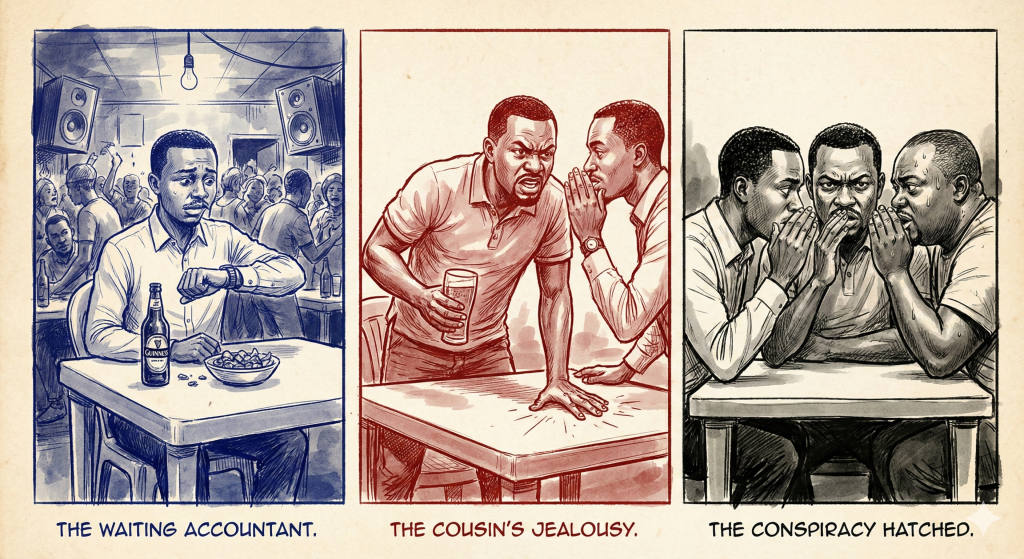
While Kwesi was receiving congratulations from his neighbours and preparing for his triumphant return to Patasi, a very different scene was unfolding just a few miles away, deep in the pulsating heart of Kumasi. It was Friday evening, the day before the Knocking ceremony. The sun had long since surrendered to the vibrant chaos of the night, and Kejetia Market was alive, not with the trade of goods, but with the trade of secrets, gossip, and schemes.
In a dimly lit corner of the market, away from the main thoroughfares where the kayayei (head porters) slept on their pans, there was a small, unassuming drinking spot known simply as “Blue Kiosk.” It was a place where the music was always too loud, Highlife rhythms thumping against the plywood walls, and the air was thick with the scent of kebabs grilling on open charcoal fires and the pungent aroma of locally brewed gin.
Kojo sat at a plastic table in the far corner, nursing a bottle of Guinness. He checked his watch for the third time in ten minutes. The accountant looked out of place here. His shirt was too crisp, his trousers too sharply creased for the concrete floor. He kept dabbing his forehead with a handkerchief, not just from the heat, but from a nervousness that he couldn’t quite shake. Every time the curtain at the entrance parted, he jumped slightly.
“Relax, my friend,” the barman shouted over the music as he dropped a bowl of spicy gizzards on the table. “You look like you’re waiting for the tax man.”
Kojo forced a smile. “Something like that.”
The tax man would be preferable, Kojo thought. If the external auditors came, he could perhaps charm or bribe them. But Kwesi Dankwa? Kwesi was different. Kwesi was meticulous. Kwesi checked every invoice, every waybill. And if Kwesi became Regional Director on Monday, he would have access to the archives. He would see the discrepancies in the transport ledger from three years ago. He would see the phantom trucks, the inflated fuel costs, the payments to shell companies. Kojo wasn’t just losing a promotion; he was staring down the barrel of a prison sentence.
The path to the Blue Kiosk had started two days earlier, on a dusty afternoon in Bantama. Kojo, driven by a gnawing anxiety about his impending exposure, had taken a drive to Kwesi’s neighbourhood. He wasn’t sure what he was looking for—dirt, weakness, or just confirmation that the man who was about to ruin him had humble roots.
He had stopped his car by a small provisions shop to buy a bottle of water. He was wearing his company polo shirt, the “Ashanti Cocoa Buying Company” logo emblazoned on the chest. As he paid, the shopkeeper, a sweating, stout man with shifty eyes, had stared at the logo.
“Ashanti Cocoa?” the shopkeeper, Agyeman, had asked, wiping his hands on a rag. “You work with that boy? Kwesi Dankwa?”
Kojo had paused, sensing an opening. “Yes. He’s my colleague. Do you know him?”
Agyeman had let out a bitter laugh. “Know him? I knew him when he was running around here in shorts. Now he comes back from Tema, throwing money like he owns this place. Arrogant little…”
Kojo had leaned in, his interest piqued. “He can be difficult. He thinks he’s better than everyone.” Kojo added.
“Better? He’s nothing!” Agyeman spat. “Just because he has a big job. He forgets where he came from. Even his own cousin, Osei, can’t stand him. Instead of helping him, Kwasi asked him to go work as a bookman at a taxi station. The poor boy is struggling while Kwesi builds palaces, and circles around his woman”
“Osei?” Kojo asked. “Does he live around here?”
“He’s comes around every few days… when he not at the Blue Kiosk in Kejetia, drinking away his sorrows.
“I will like to meet Osei, maybe help him find a job” Kojo said. “Do you have is his contact?”
Agyeman had scribbled a number on a scrap of paper. “Tell him Agyeman sent you.”
And that was how Kojo found himself here, two days later, sitting in the pulsating heart of Kejetia Market on a Friday night.
The curtain parted again, and this time, the man Kojo was waiting for stepped in.
Osei looked nothing like the corporate figure Kojo cut. He wore a faded polo shirt that clung to his broad shoulders and jeans that had seen better days. But he walked with a swagger that commanded space. He scanned the room with eyes that were perpetually narrowed, as if measuring everything for a fight. When he spotted Kojo, a slow, lazy grin spread across his face.
“Accountant!” Osei boomed, pulling out the plastic chair opposite Kojo. The legs scraped loudly against the concrete floor. “You look like you’ve seen a ghost.”
“Keep your voice down,” Kojo hissed, leaning in. “Did anyone see you come here?”
“This is Kejetia, my friend. Everyone sees everyone, and no one sees anything. Relax.” Osei signalled the barman for a beer without even turning his head. “So, why the urgent summons? Did your calculator break?”
“It’s about your cousin,” Kojo said, the name tasting like bile in his mouth. “Kwesi.”
Osei’s grin vanished instantly. His face hardened, the playful light in his eyes replaced by a cold, simmering resentment. “What about him? I saw him a few days ago, he’s back and rubbing his success in our faces again, ‘Oh, look at me, the big man from Tema.'”
“Worse,” Kojo said, watching Osei carefully. “He’s back to stay. He’s being promoted. Regional Director. He’ll be running the whole Ashanti operation starting Monday.”
Osei slammed his hand on the table, making the bottles jump. “Regional Director? Him? That self-righteous boy? When I saw him a few days ago he said big changes were coming, so that’s what he meant! And I am here struggling to find a trotro to drive?”
“It gets better,” Kojo added, dropping the second bombshell. “He’s marrying Abena. The Knocking ceremony is tomorrow. He’s fast-tracking it.”
The silence that followed was heavy. Osei stared at his beer bottle, his jaw working. Abena. The name hung between them. Kojo knew Osei had always wanted her, had always felt entitled to her, just as he felt entitled to the success Kwesi had earned. To Osei, Kwesi wasn’t just a cousin; he was a thief who had stolen the life Osei believed should have been his.
“He takes everything,” Osei muttered, his voice low and dangerous. “The good grades, the praise from the elders, the good job… and now Abena.”
“He’s going to destroy us, Osei,” Kojo whispered, fueling the fire. “Once he’s Regional Director, he’ll look down on you even more. He’ll offer you scraps from his table, maybe a job cleaning his car. Is that what you want? To be his servant?”
“Never,” Osei spat.
“You are right, he told me he will make me his clerk, a whole me, a clerk!” Osei said as he slapped his chest with both palms.
“Then we have to stop him. Before Monday. Before the ceremony seals it.”
“Stop him how?” Osei asked, looking up. “He’s the golden boy. He’s untouchable.”
“No one is untouchable,” Kojo said, a sly smile creeping onto his face. “Everyone has a secret. Or if they don’t… we can give them one.”
Just then, the curtain parted a third time. A short, sweating man waddled in, wiping his face with a greasy towel. It was Agyeman, the shopkeeper from Bantama. He looked flustered, his eyes darting around until they landed on the pair in the corner.
“Ah, there you are,” Agyeman panted, pulling up a chair uninvited. “You said there was business to discuss? Money to be made?”
Kojo leaned back, satisfied. The cast was assembled. Envy, Jealousy, and Greed. All sitting at one table in the heart of Kejetia.
“Yes, Mr. Agyeman,” Kojo said smoothly. “We are discussing a business transaction. One that involves removing a certain… obstacle.”
Agyeman’s eyes lit up. “An obstacle? Does this obstacle have a name?”
“Kwesi Dankwa,” Osei said, the name dripping with venom.
Agyeman let out a bitter laugh. “That boy? I was at his home, he was throwing money around like a politician. Paid off his father’s debt and looked at me like I was dirt. ‘Keep the change,’ he said. Arrogant.”
“Exactly,” Kojo said. “He thinks he’s better than us. He thinks he can buy everyone. But what if… what if the police found out that his money wasn’t so clean after all?”
The three men leaned in, their heads almost touching over the centre of the table. The noise of the market faded into the background as the plot began to take shape, woven from the threads of their collective bitterness. In the dim light of the Blue Kiosk, the fate of Kwesi Dankwa was being sealed by the petty malice of men.