Saturday morning in Kumasi arrived with a festive brightness, the sun glinting off the metal roofs. The sky was a brilliant, cloudless blue, the kind that promised heat and celebration in equal measure. In Bantama, Opanyin Dankwa’s compound was a beehive of activity.
Uncle Gyasi had arrived from Ejisu, along with Agya Menu, the Abusuapanin—head of the extended family—their GTP wax cloths draped over their shoulders with regal elegance. Auntie Yaa and Auntie Esi were in matching traditional Ghanaian two-piece outfits, consisting of a tailored top (Kaba) and a matching skirt (Slit). Even at his age, Opanyin Dankwa looked distinguished in his best cloth, a rich blue and black cloth that he had saved for a special occasion.
Kwesi stood by the small mirror in his room, adjusting his cloth. It was a heavy, hand-woven white and blue kente. He had rented it for the occasion, but looking at his reflection, he felt a surge of pride. He didn’t just see a logistics manager; he saw a man ready to build a legacy. He looked like a man who belonged in such finery. He looked like a Director.
“Kwesi! Are you still admiring yourself?” his father’s voice called out from the courtyard, laced with a teasing affection. “The family will be waiting.”
“I am coming, Papa,” Kwesi replied, smoothing down the folds one last time. He grabbed his phone and wallet, taking a moment to check the notifications. Still no official confirmation from the board, but Mr. Mensah had assured him it was a done deal. He pushed the thought aside. Today wasn’t about work. Today was about Abena.
When Kwesi stepped out, Uncle Gyasi exclaimed, “You look like a chief!” clapping him on the back. “Today, we go to take a flower from their garden.”
The neighbours who were out and about paused to greet them, shouting congratulations and well-wishes. Even Maame Serwaa, usually so cynical, offered a genuine wave from her stall. It felt like the whole of Bantama was behind him, cheering him on towards his happiness.
The procession to Patasi was a convoy of three taxis, filled with family members carrying bottles of Schnapps, a few crates of minerals, and the hopeful anticipation of a union.
Down the street, in the shadowed interior of his kiosk, Agyeman watched the taxis disappear around the corner. He wasn’t smiling. He was on his phone, his voice low and urgent.
“They have left,” he muttered into the receiver. “Yes, just now. He is wearing the white and blue kente. You can’t miss him. He looks… too happy.”
He listened for a moment, then nodded. “Don’t worry about the old man. He is frail. Once the son is out of the way…” He let the sentence trail off, a cruel smile touching his lips. “Just make sure it is done properly. I don’t want him coming back here asking questions.”
He hung up and leaned back against his counter, surrounded by tins of milk and packets of biscuits. He picked up a calculator and started punching in numbers, humming a tuneless song to himself. The envy that had been gnawing at him for days had settled into a cold, hard resolve. Kwesi Dankwa thought he was better than them. He thought he could just fly away and leave them in the dust. Well, Agyeman thought, gravity has a way of bringing everyone back down to earth.
Meanwhile, in the taxi, Kwesi felt a sudden shiver, despite the heat.
“Are you cold?” his father asked, noticing the movement.
“No, Papa,” Kwesi said, rubbing his arms. “Just… nerves, I suppose. It’s a big day.”
“It is the biggest day,” Opanyin Dankwa agreed. “But do not fear. You have done everything right”.
Kwesi nodded, forcing himself to relax. His father was right. He had nothing to fear. He had earned this happiness. He pictured Abena again, waiting for him in her own finery, and the cold feeling vanished, replaced by a warm glow of anticipation.
As they arrived at the Oforis’ house, the atmosphere was cordial but ceremonial. The Oforis had engaged Agya Kofi Ofori as the family spokesperson (Okyeame) to receive the visitors, and the formal exchange of greetings began—the intricate, beautiful dance of Akan tradition where every word is measured and every gesture has meaning.
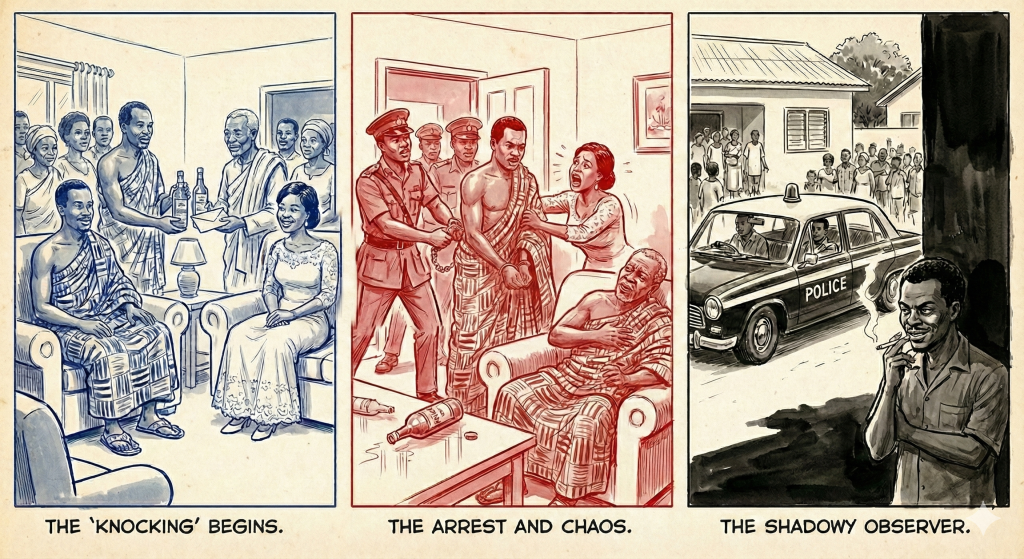
They sat in the living room, the furniture pushed back to accommodate the guests. Uncle Gyasi, the designated Okyeame for Kwesi’s family, stood up, lowering his cloth from his shoulder as a sign of respect.
“Grandfathers, grandmothers, fathers and mothers,” he began, his voice melodic. “We did not come here for any bad reason. We saw a beautiful flower in this house, and our son, Kwesi Dankwa, says he cannot sleep because of its beauty. We have come to knock on your door, to ask for the hand of your daughter, Abena, in marriage.”
He presented the two bottles of Schnapps and the envelope of money on the centre table. The room went silent as Agya Kofi Ofori, the Oforis’ spokesperson, inspected the items. A nod was given. The acceptance was signalled.
Agya Kofi Ofori called Abena into the room. She was radiant, dressed in a white lace outfit that accentuated her grace. She shyly confirmed to Agya Kofi Ofori that yes, she knew the visitors, and yes, she accepted their proposal. Cheers erupted. Opanyin Dankwa wiped a tear from his eye. This was the proudest moment of his life.
Uncle Gyasi rose and called on Agya Kofi Ofori, his opposite Okyeame, to express thanks from the Dankwa family to the Ofori family. As Agya Kofi Ofori stood up, the sound of heavy boots crunching on the gravel outside cut through the joyous chatter. The front door, which had been left ajar for air, was pushed open with aggressive force.
The room froze.
Three uniformed police officers and a man in a plain suit entered. The man in the suit scanned the room, his eyes landing coldly on Kwesi.
“Is there a Mr. Kwesi Dankwa here?” he barked.
Kwesi stood up, confusion clouding his face. “I am Kwesi Dankwa.”
“You are under arrest,” the man said, pulling out a pair of handcuffs.
“Arrest?” Kwesi laughed nervously, looking at his uncles. “For what? Is this a joke?”
“This is no joke, sir. You are under arrest for fraud, embezzlement, and smuggling of cocoa products at the Tema Harbour. We have a warrant to search your premises and take you into custody immediately.”
A gasp went through the room. Opanyin Dankwa tried to stand, his cane clattering to the floor. “No! This is a mistake! My son is a good man!”
“Save it for the judge, old man,” the officer sneered. He grabbed Kwesi by the arm, spinning him around. The cold steel of the handcuffs clicked shut, echoing loudly in the silent room.
Abena screamed, a raw, terrifying sound that shattered the peace of the morning. She rushed forward, grabbing Kwesi’s arm. “Kwesi! Tell them! Tell them it’s not true!”
“It’s not true, Abena! I haven’t done anything!” Kwesi shouted, struggling against the officer’s grip. “Let me go! This is a setup!”
“Move!” the officer commanded, shoving him towards the door.
As they dragged him out, Kwesi looked back. He saw the overturned bottle of Schnapps on the table, the liquor spilling onto the carpet. He saw his father clutching his chest, collapsing into Uncle Gyasi’s arms. He saw Abena being held back by her mother, tears streaming down her face, her white lace dress stark against the scene of chaos.
Outside, a crowd had gathered. Among them, partially hidden by the shade of a mango tree across the street, stood a figure watching intently. It was Osei. He took a long drag of his cigarette, a smirk ghosting his lips, before he turned and walked away into the shadows.
The police car door slammed shut, sealing Kwesi in. As the siren wailed, signalling the end of the ceremony and the beginning of his nightmare, Kwesi realised with a sinking heart that the storm had not just broken; it had swept away his entire world.