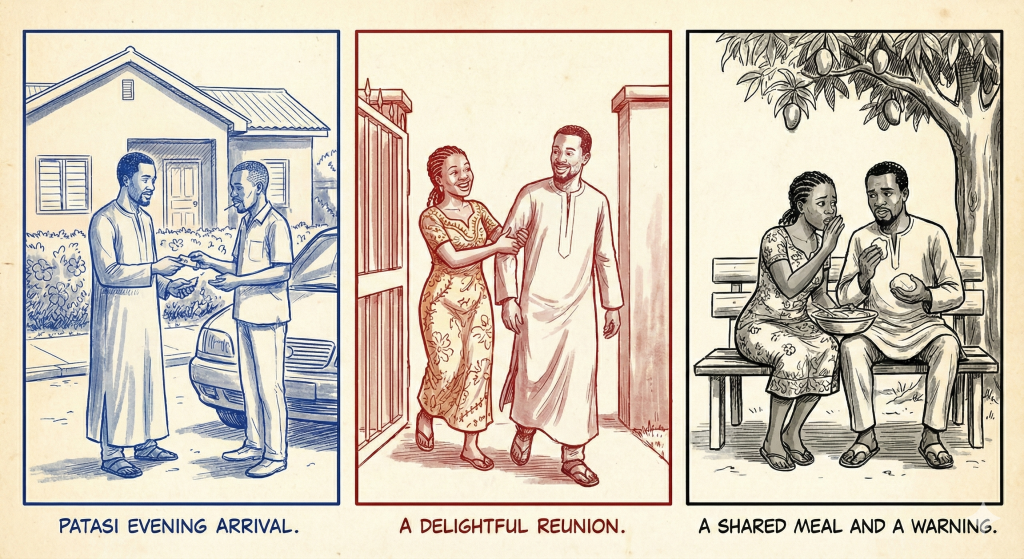
The journey from Bantama to Patasi was not long, but in the gathering dusk of a Kumasi evening, it felt like a voyage between two worlds. Kwesi flagged down a taxi at the roadside, the driver, a young man with a toothpick dancing between his lips, nodding as Kwesi gave the destination. As the car navigated the roundabouts and the busy intersections, Kwesi watched the city transform. The dense, communal clustering of Bantama gave way to the slightly more spacious, tree-lined avenues of the residential estates in Patasi.
The taxi pulled up in front of a neat, modest house painted in a cheerful shade of peach. Hedges of hibiscus lined the front wall, their red flowers folded shut for the night. Kwesi paid the driver and stepped out, his heart doing a familiar, nervous flutter that no amount of corporate success could quell.
He knocked on the metal gate, a specific rhythm, tap-tap-pause-tap, their secret code since secondary school.
A moment later, the small pedestrian door creaked open.
Abena stood there.
She was wearing a simple house dress of yellow batik, her hair braided back neatly in cornrows that highlighted the elegant curve of her neck. She looked tired, perhaps from a long day of chores or helping her mother in her shop, but when she saw him, her face transformed. It was like watching the sun break through the harmattan haze.
“Kwesi!” she breathed, her voice a mix of relief and delight.
“Abena.”
She pulled him inside quickly, checking the street almost instinctively before closing the gate. ” You are back! I heard rumours, but I didn’t want to believe until I saw you.”
“Rumours travel faster than fibre optics in this town,” Kwesi laughed, taking her hands. They were rougher than usual, calloused from work. He rubbed his thumb over her knuckles gently. “I came straight from seeing the old man.”
“How is Opanyin?”
“He is well. Eating better tonight than he has in a long time, I made sure of that.” Kwesi paused, looking deep into her dark eyes. “But I didn’t come just to give you a health report.”
Abena raised an eyebrow, a playful smile touching her lips. “Oh? Did you come to beg for jollof?”
“Better,” Kwesi grinned. He couldn’t hold it in any longer. The news was burning a hole in his chest. “Mr. Mensah called me after my return from Tema. The Board meeting is next week.”
Abena went still. “And?”
“And… he is putting my name forward. For Regional Director. He says it is mine, Abena. It is done.”
Abena let out a squeal of joy, throwing her arms around his neck. Kwesi caught her, spinning her around in the small courtyard, her laughter mingling with the distant sounds of the city. For a moment, they were just two young people in love, the weight of their responsibilities lifted by the buoyancy of success.
“Director Dankwa!” she teased as he set her down, though her eyes were shining with tears. “I knew it. I always knew it. Even when you were just a tally clerk checking sacks.”
“It means we can move forward,” Kwesi said, his voice turning serious, intense. “It means I can go to your father with my head high. I want to do the customary marriage, Abena. Proper. Next month.”
Abena’s smile softened into something tender and profound. She reached up, adjusting the collar of his kaftan. “My father respects you, Kwesi. He knows you are a good man. The title is just… extra decoration.”
“In this world, decoration matters,” Kwesi replied, perhaps a bit more cynically than he intended. He thought of Agyeman, of Kojo, of Osei. “It protects us.”
“We protect us,” Abena corrected him gently. “Come, sit. Mama has made fufu. If you leave here without eating, she will say I am starving her future son-in-law.”
They sat on the wooden bench under the mango tree in the centre of the yard. The air was cooling, the heat of the day radiating off the concrete. Abena brought him a bowl of water to wash his hands, and they ate together from a shared bowl, the intimacy of the act speaking louder than any grand declarations.
As they ate, Kwesi watched her. She was beautiful, yes, but she was also solid. She was the anchor to his soaring ambitions. He told her about his plans for the company, about the digitisation project, about his vision for a corruption-free logistics chain. She listened intently, asking sharp questions, reminding him of the practicalities he sometimes overlooked in his idealism.
“You have to watch your back, Kwesi,” she said quietly, echoing his father’s earlier warning. “Not everyone will be happy for you. That accountant… Kojo?”
“He is just noise,” Kwesi dismissed, waving a hand. “He can’t stop progress.”
“Progress upsets people who profit from stagnation,” Abena murmured. She looked towards the gate, a sudden frown marring her forehead. “Even family. Have you seen Osei?”
“Briefly. On the road.”
“He was here yesterday,” Abena said, lowering her voice. “Asking about you. Asking… strange questions. About when you were coming back, about the shipment details.”
Kwesi paused, a piece of fufu halfway to his mouth. “Osei? Why would he care about shipments?”
“I don’t know. But he looked… desperate, Kwesi. And he was with a man I didn’t know. Someone with a hard face.”
A chill ran down Kwesi’s spine, dampening the warmth of the meal. He remembered Agyeman’s greed, Kojo’s envy, and now Osei’s strange inquiries. It felt like invisible threads were being woven around him, a net tightening in the dark.
“Don’t worry about Osei,” Kwesi said, forcing a confidence he didn’t quite feel. “He is family. He is just… lost. When we are settled, we will help him.”
Abena placed her hand over his. “You are too good, Kwesi. That is your strength. Don’t let it be your weakness.”
They sat in silence for a moment. Kwesi squeezed her hand. He wouldn’t let fear spoil this. He had won. He was the Director. He was going to marry the woman he loved.
“Next week,” he whispered, a promise to her and to himself. “Next week, everything changes.”
He didn’t know how right, and how terribly wrong, he was.